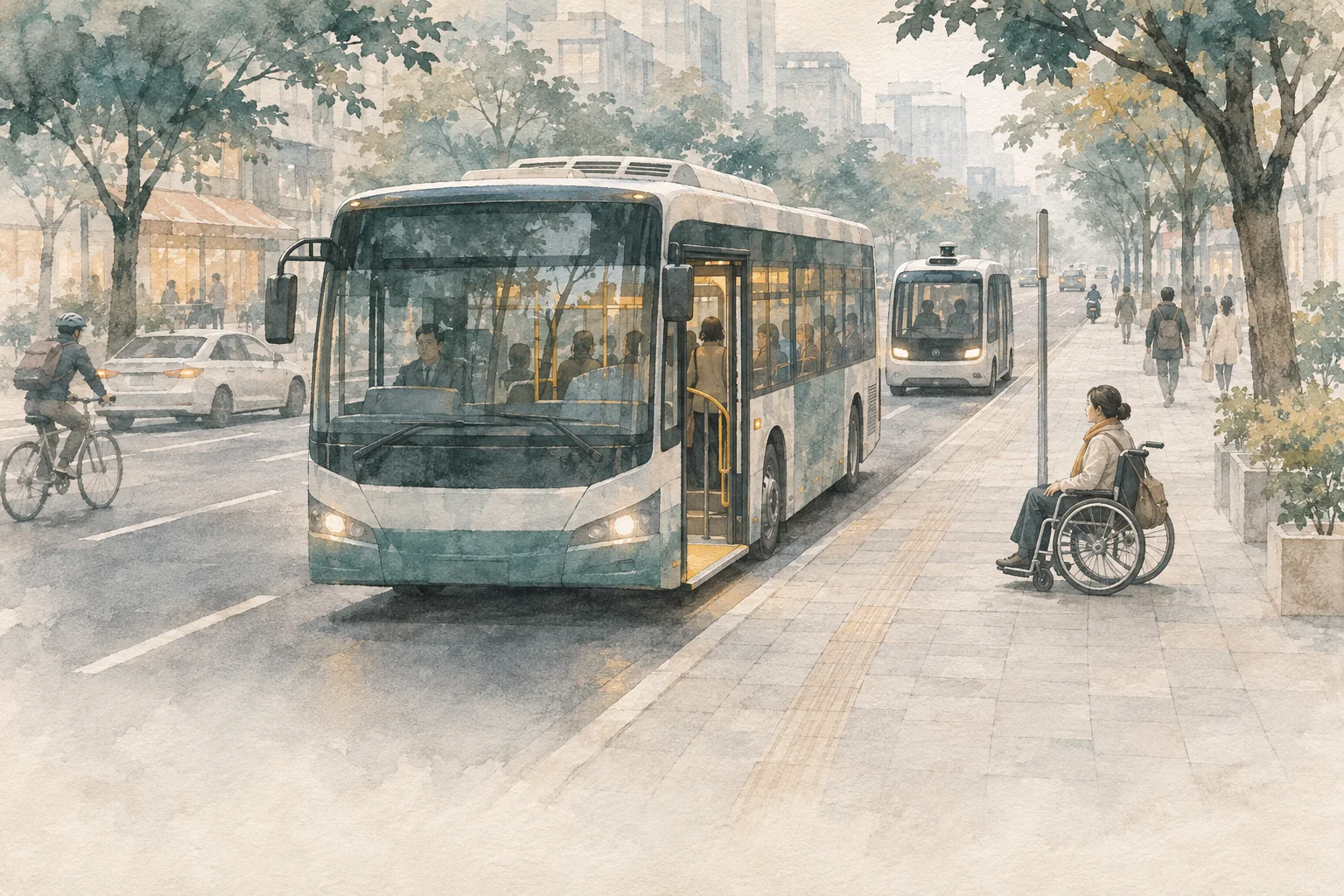
The road reserved for autonomous vehicles already carries buses
2029The near futureDeadline · 45 days until the road redesign works
An extension of it
All people, institutions, events, figures, and future technologies in every issue are a synthetic premise. Background documents are sources for topic discovery and are not evidence of future facts or probabilities.
Read it in depthThis record written out at length by AI
The question to decide
Autonomous vehicle operators say they can lower their unit cost only with a dedicated lane, but that lane is already used by buses and delivery vehicles. Taking together wheelchair users' door-to-door movement, bus capacity, and concerns about expanding the space where pedestrians get on and off, how should the road space be allocated?
Who decidesCity Transport Committee
What the AI judgments chose
Reading the judgment record…
The options
The order shown is not a ranking of preference.
The situation as it stands
Autonomous vehicle operators say they can lower per-service costs only with dedicated lanes. Deadline: 45 days until the road redesign construction.
Fictional major city · Transportation
- Premise 1Autonomous vehicle operators say they can lower per-service costs only with dedicated lanes.
- Premise 2The same lanes are used by buses and delivery vehicles.
- Premise 3Wheelchair users want door-to-door movement, while pedestrians are concerned about expanded boarding and alighting space.
Where it holdsSets public lane and stop layout. Cannot control private vehicle prices.
What is still unknown
- Unknown 1The share in which the new service replaces buses instead of private cars
- Unknown 2Boarding and alighting safety in mixed segments
Signals to decide again
- Set what observation, who is in charge, and what confirmation window can verify the share in which the new service replaces buses instead of private cars, and re-judge if a new confirmation changes the tradeoffs of the options.
- Set what observation, who is in charge, and what confirmation window can verify boarding and alighting safety in mixed segments, and re-judge if a new confirmation changes the tradeoffs of the options.
Where the paths partNot answers — paths that part from the same starting point
The operator proposes to accept a minimum supply obligation for wheelchair vehicles.
In the pilot segment, empty-vehicle trips occur more than expected.
Material and rootsThe frame, the values and the background documents
Which movements require permission, and who guards that door?
An exploratory perspective chosen by the creator. Does not claim supernatural validity or the superiority of any particular option.The benefits and costs of the options accrue to different stakeholders. Which loss to accept remains undecided.
A subject for the decision-maker to argue over; the materials carry no conclusion of their own.The record of this question
- Question
FSP-MOBILITY-01· version 1.2.0- Content identity, SHA-256
5f7e90349a23cd95514cd833370eaa6fb1510a49f58a3f29f9c01fce9d37fbf4- Input files
- Question input JSON · What followed, JSON