4.1The claim
The historical claim of this section is that Thucydides' account of the Mytilenean debate, read in Crawley's translation, is a narrative about the time between a decision and its execution as much as it is a narrative about mercy or rhetoric, and that it identifies, without naming them as such, the conditions under which a reversal can reach the point of execution in time. The section adds to the debate between Collingridge and Clarke a case in which a correction was decided, carried and enforced, and in which each of those three steps depended on something other than the wording of the correcting decree.
4.2The first decree and the morning after
The episode opens after Mytilene (Crawley spells it Mitylene) has revolted from Athens and surrendered to the Athenian commander Paches, who sends to Athens the Spartan agent found hiding in the town, together with the Mytilenians held on Tenedos and others thought concerned in the revolt. Thucydides then gives the first decision in a single sentence.
Upon the arrival of the prisoners with Salaethus, the Athenians at once put the latter to death, although he offered, among other things, to procure the withdrawal of the Peloponnesians from Plataea, which was still under siege; and after deliberating as to what they should do with the former, in the fury of the moment determined to put to death not only the prisoners at Athens, but the whole adult male population of Mitylene, and to make slaves of the women and children.
The sentence moves from an execution done at once to a decision taken in fury without a pause. Thucydides next gives the reasons for the anger, and the order that carried the decree.
It was remarked that Mitylene had revolted without being, like the rest, subjected to the empire; and what above all swelled the wrath of the Athenians was the fact of the Peloponnesian fleet having ventured over to Ionia to her support, a fact which was held to argue a long meditated rebellion. They accordingly sent a galley to communicate the decree to Paches, commanding him to lose no time in dispatching the Mitylenians.
The order is a decree with a carrier and an instruction about time. It has left Athens; what it now needs is a reader at Lesbos and an executioner's hand. Then comes the change of mind.
The morrow brought repentance with it and reflection on the horrid cruelty of a decree, which condemned a whole city to the fate merited only by the guilty. This was no sooner perceived by the Mitylenian ambassadors at Athens and their Athenian supporters, than they moved the authorities to put the question again to the vote; which they the more easily consented to do, as they themselves plainly saw that most of the citizens wished some one to give them an opportunity for reconsidering the matter.
Three things in this passage bear on the question of an observable stop. The reconsideration does not begin with the decider: it begins with the envoys of the condemned city and their Athenian supporters, the people who faced the danger, who saw the change of feeling and acted on it. The procedure for reopening exists and is used; nothing suggests that the Athenians had to invent a way to vote again. And the authorities consent because they see what most citizens want. The reopening is a matter of who asks and how quickly, not of whether it is allowed.
4.3Cleon against reopening
Cleon, the man who had carried the first motion and whom Thucydides calls the most violent man at Athens and by far the most powerful with the commons, speaks first. His speech is the classic case against corrigibility. Its first argument is about the authority of a decision that does not change.
The most alarming feature in the case is the constant change of measures with which we appear to be threatened, and our seeming ignorance of the fact that bad laws which are never changed are better for a city than good ones that have no authority; that unlearned loyalty is more serviceable than quick-witted insubordination; and that ordinary men usually manage public affairs better than their more gifted fellows.
Here is the position most directly opposed to Collingridge's. For Cleon a decision's value lies partly in its staying made: a law that may be changed has less authority than a worse law that may not. Cleon's second argument is about time, and it is the only place in the debate where delay itself is named as a cost.
For myself, I adhere to my former opinion, and wonder at those who have proposed to reopen the case of the Mitylenians, and who are thus causing a delay which is all in favour of the guilty, by making the sufferer proceed against the offender with the edge of his anger blunted; although where vengeance follows most closely upon the wrong, it best equals it and most amply requites it.
On this view the interval between decision and act is not a chance to correct but a leak through which the decision's strength escapes. The delay, Cleon says, is all in favour of the guilty. The speech goes on to blame the assembly for treating oratory as a spectacle and to argue that sparing Mytilene's people will invite every ally to revolt, and it closes with a refusal of reversal in plain terms.
I therefore, now as before, persist against your reversing your first decision, or giving way to the three failings most fatal to empire—pity, sentiment, and indulgence.
Cleon's case is complete and coherent: a decision once taken should hold because its authority depends on its holding, because delay erodes the motive that made it right, and because reconsideration rewards speech over what was seen. Cleon's premise runs against Collingridge's note, which recommends keeping decisions easy to correct, and only partly meets Jonas's, which gives the bad prognosis priority where stakes are irreversible; the speech gives no such priority to the irreversible killing it urges.
4.4Diodotus for deliberation
Diodotus, who had spoken most strongly against the killing in the first assembly, answers. He begins with reopening itself.
I do not blame the persons who have reopened the case of the Mitylenians, nor do I approve the protests which we have heard against important questions being frequently debated. I think the two things most opposed to good counsel are haste and passion; haste usually goes hand in hand with folly, passion with coarseness and narrowness of mind.
The opening defends exactly what Cleon attacked: the reopened case and the frequent debate of important questions. The enemies of good counsel are named as haste and passion, which is to say the conditions under which the first decree was passed. Diodotus then makes a remark about responsibility that bears directly on Luhmann's distinction between risk and danger.
For if those who gave the advice, and those who took it, suffered equally, you would judge more calmly; as it is, you visit the disasters into which the whim of the moment may have led you upon the single person of your adviser, not upon yourselves, his numerous companions in error.
Diodotus has identified a mismatch between who chooses and who bears the cost of the choice, and named it as a source of hasty judgment. The assembly decides; the adviser answers. Neither, it may be added, is the party who would die. The centre of the speech changes the question from guilt to interest, and from the present to the future.
I consider that we are deliberating for the future more than for the present; and where Cleon is so positive as to the useful deterrent effects that will follow from making rebellion capital, I, who consider the interests of the future quite as much as he, as positively maintain the contrary.
Diodotus argues that the death penalty does not deter, and offers a different timing of control.
We must not, therefore, sit as strict judges of the offenders to our own prejudice, but rather see how by moderate chastisements we may be enabled to benefit in future by the revenue-producing powers of our dependencies; and we must make up our minds to look for our protection not to legal terrors but to careful administration. At present we do exactly the opposite. When a free community, held in subjection by force, rises, as is only natural, and asserts its independence, it is no sooner reduced than we fancy ourselves obliged to punish it severely; although the right course with freemen is not to chastise them rigorously when they do rise, but rigorously to watch them before they rise, and to prevent their ever entertaining the idea, and, the insurrection suppressed, to make as few responsible for it as possible.
That sentence places control before the act rather than after it, and it limits the number held responsible once the act is over. It is the closest the debate comes to a theory of the stop: watch before, and narrow the reach of punishment after. Diodotus ends by pointing to the people of Mytilene, who took no part in the revolt and surrendered the town once they had arms, and by warning that killing them would hand the oligarchs of every other city the support of their own people. Neither speech says how a reversal would reach Lesbos in time. That is left to the narrative.
4.5The race
The vote is close.
The two opinions thus expressed were the ones that most directly contradicted each other; and the Athenians, notwithstanding their change of feeling, now proceeded to a division, in which the show of hands was almost equal, although the motion of Diodotus carried the day.
Then the second galley leaves.
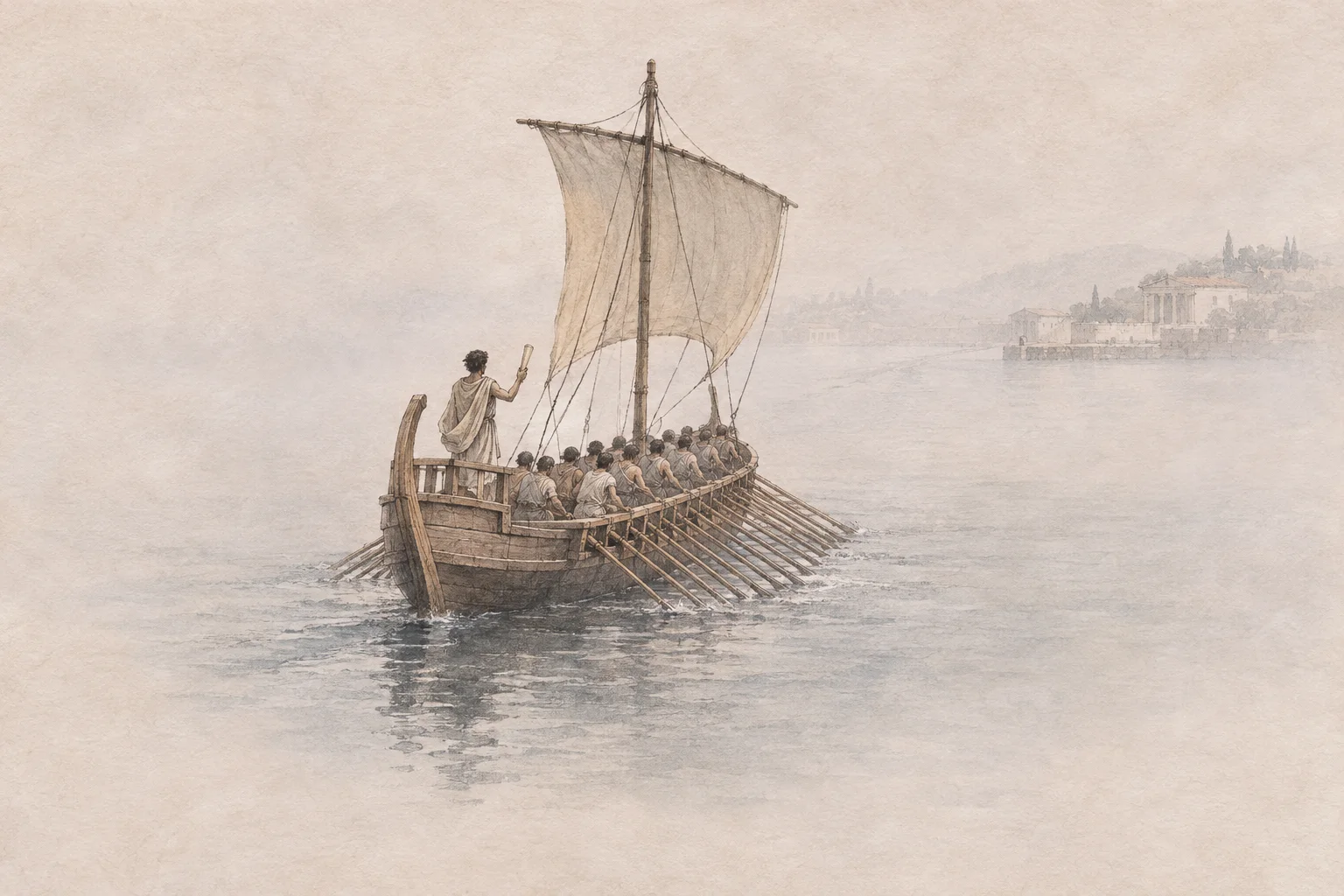
Another galley was at once sent off in haste, for fear that the first might reach Lesbos in the interval, and the city be found destroyed; the first ship having about a day and a night’s start.
The sentence gives the reason for haste and the size of the gap in the same breath. The Athenians know when the first ship left; they can reckon how much the second must gain. What follows is the race itself.
Wine and barley-cakes were provided for the vessel by the Mitylenian ambassadors, and great promises made if they arrived in time; which caused the men to use such diligence upon the voyage that they took their meals of barley-cakes kneaded with oil and wine as they rowed, and only slept by turns while the others were at the oar. Luckily they met with no contrary wind, and the first ship making no haste upon so horrid an errand, while the second pressed on in the manner described, the first arrived so little before them, that Paches had only just had time to read the decree, and to prepare to execute the sentence, when the second put into port and prevented the massacre. The danger of Mitylene had indeed been great.
Every element of the passage is a condition of the stop's success. The crew is supplied and promised rewards by the Mytilenian envoys, the people facing the danger. The rowers eat at the oar and sleep in turns. The wind does not turn against them, and Thucydides calls that luck. The first ship goes slowly because its errand is horrid. Paches has read the decree and is preparing to execute it when the second ship arrives; the interval of reading is the interval the second ship fills. The closing sentence says how near it came.
The episode does not end there, and an honest reading must not end it there either.
The other party whom Paches had sent off as the prime movers in the rebellion, were upon Cleon’s motion put to death by the Athenians, the number being rather more than a thousand.
The walls of Mytilene were then pulled down and its ships taken. The reversal saved the city's people, not the prisoners already in Athenian hands, whose case Diodotus himself had proposed to try. There was no galley to send for them, because no distance lay between the assembly's decision and its execution.
4.6What the galley made observable
Read with Collingridge and Clarke in mind, the race shows five conditions under which the reversal took effect. None of them is a property of the second decree's text.
The first is a known head start. The Athenians knew when the first ship had left, and so roughly how long the second had. The deadline was set not by the decider but by the first decision's carrier, and anyone in the city could reckon it: either the second ship could make up the difference or it could not.
The second is a carrier with its own reasons to hurry. The correction moved at the speed of those who needed it, not of those who ordered it; in Luhmann's terms, the stop was carried by the party for whom the loss was a danger.
The third is a reader at the far end. Paches had to read the decree before acting, and that moment of reading, short as it was, was the interval into which the second ship arrived. An order that executes itself on arrival leaves no such interval.
The fourth is an act not yet done. The first decree had been dispatched but not carried out, so the reversal reached the city while the decision was still, in Collingridge's sense, correctable. The men already at Athens were in a different position: Diodotus' own motion had left them to be tried, their fate was settled where they stood, and no interval of travel stood between that decision and its execution.
The fifth is luck. There was no contrary wind, and the first ship was slow, its crew in no hurry to carry such an order. A stop that depends on the wind is not a mechanism; it is a chance the mechanism was able to use.
Measured against these five, the wording of the second decree hardly matters. Applied here, Clarke's test has a strange answer: the second decree could work as written only because of things that were not written in it.
4.7What the case adds
This section adds to the debate between Collingridge and Clarke a case in which correction was decided, carried and enforced, and in which success depended on the interval between decision and act, on the motives of the carrier, on a reader at the point of execution, and on chance. It suggests that Collingridge's corrigibility needs a further condition, that the correcting signal can reach the point of execution before the act, and that Clarke's test should be extended to ask what the plan relies on that it does not write down.