1.1The question
Every decision about force contains a decision about stopping. When a recall is written down at all, it is usually written as a condition (if this happens, then reconsider) rather than as a mechanism that someone outside the deciding body could watch working. A condition that only the decider can check depends on the decider's attention, which is the thing most likely to be absorbed elsewhere when the condition arrives. A stop that others can observe, carry and enforce at the point of execution does not.
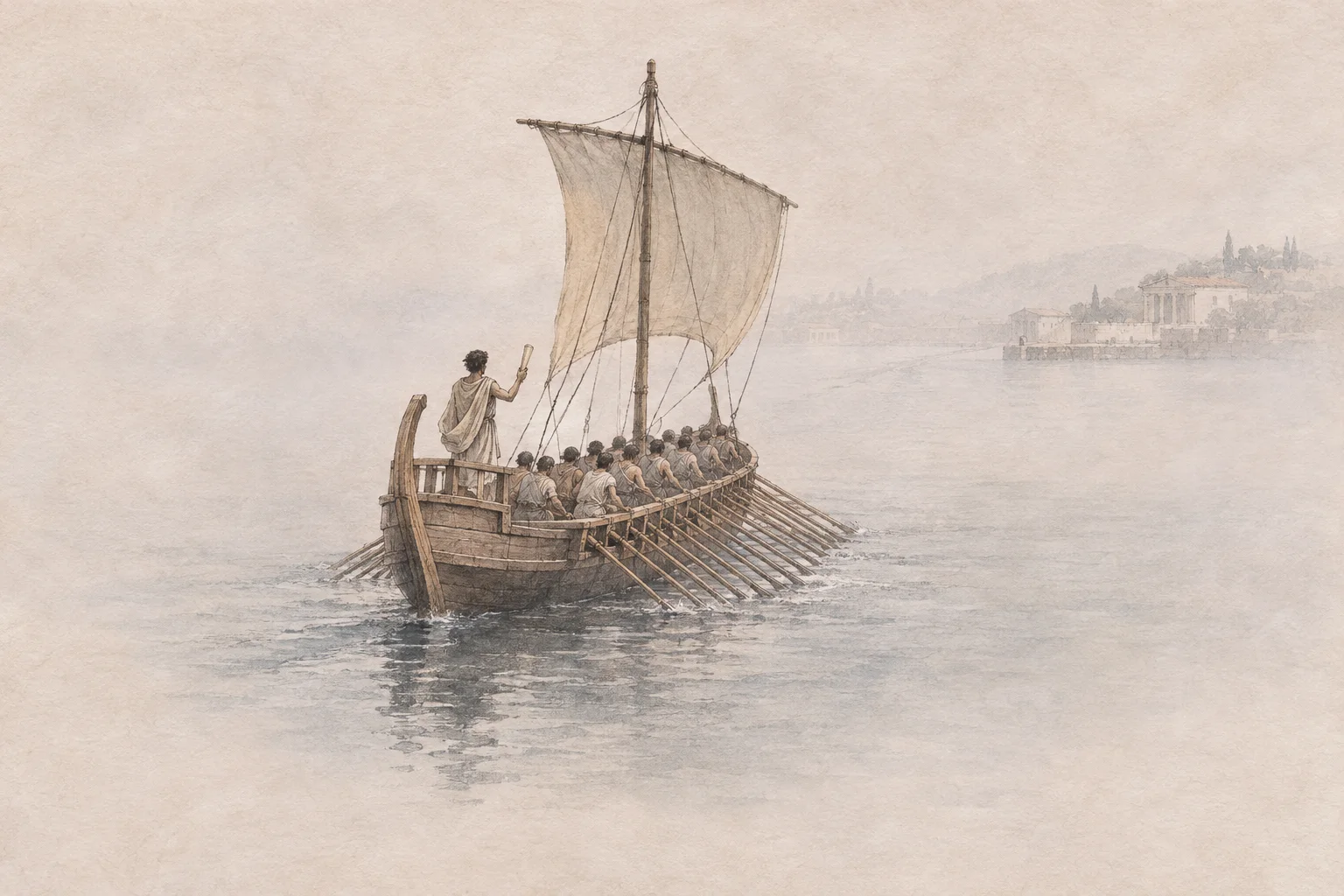
This article asks what makes an order to stop observable rather than merely written. It puts the question to an old text and two new documents. The old text is Thucydides' account, in Book III, of the Athenian decision about Mytilene in 427 BC, reversed overnight, with the answer reaching the place of execution just in time. The new documents are two records published on Meridian, the decision-record platform of the RISCON family, which set out decisions in fictional polities before their outcome is known: a ceasefire verification board deciding, by noon on a fixed day in 2031, who keeps the records gathered by observation equipment, and a committee deciding, by a fixed hour in 2030, how to correct conflicting records of missing persons.
The two halves of the question differ in standing. One concerns how to read a classic text: is the Mytilenean episode only a story about mercy and rhetoric, or also one about the time between a decision and its execution? The other concerns documents written for a platform: when a record writes down what would stop or reopen its decision, does it say who would see the signal, how fast it would travel and who at the far end would read it?
1.2The contribution
The contribution is narrow, and it is a reading. One side of the debate this article joins is an argument about correctable decisions. David Collingridge (1980) holds that while a technology is young its effects cannot be known, that once they are known it is entrenched and hard to change, and that decisions should therefore be kept corrigible, which is to say easy to monitor and to correct, with options kept open. On the other side stands a warning. Lee Clarke (1999) holds that organisations write plans for catastrophes they cannot control, which he calls fantasy documents, and that such plans could not work as written but serve to persuade others, and the organisations themselves, that the risk is under control. The two positions meet whenever a document promises that a decision can be reversed. Read through Collingridge, the question is whether the decision has been made easy to monitor and correct; read through Clarke, whether the promise could work as written or serves mainly to persuade. This article calls the second question Clarke's test.
Neither position says much about the interval between the moment a reversal is decided and the moment it must take effect. The Mytilenean episode is about almost nothing else. This article proposes that Thucydides' narrative gives a concrete anatomy of a stop that worked, usable as a set of questions for any document that promises correction. The proposal adds to Collingridge's position a further condition (that corrigibility depends on the speed and route of the correcting signal), and offers a way to apply Clarke's test without waiting for a disaster.
A second, smaller contribution reads two Meridian records with that anatomy in hand. They are modern summaries written by AI for the platform, set in fictional polities; they report no real state, force or person. What they offer is a decision written before its outcome, with its stop and reopening conditions in its own words.
1.3The debate joined
Section 2 sets out the sides. On one stand Collingridge (1980), with Richard Neustadt and Ernest May (1986) and Irving Janis (1972), whose practices for the room are set beside his; Hans Jonas (1984), on irreversible stakes, gives a contrasting answer. On the other stands Clarke (1999), for whom plans for catastrophes that cannot be controlled could not work as written but serve to persuade, together with Niklas Luhmann's (1993) distinction between risk and danger, used here to ask who needs a stop condition. Fred Iklé (1971) and Virginia Page Fortna (2004) bring the question into war. Gathering these works into one debate, and applying them to Mytilene and to the records, is this article's own doing; each work is described only as far as its reading note goes, and every further step is the article's argument rather than the author's. The article does not decide between the sides. It sets the second galley and the two records against them.