7.1Five conditions, three texts
Section 4 drew five conditions from Thucydides' narrative: a known head start, a carrier with reasons to hurry, a reader at the far end, an act not yet done, and luck. The two records can be read against them, with the caution that they are synthetic documents and the conditions are this article's construction.
Both records supply the known deadline for their main decision (noon on 20 June 2031; 16:00 on 6 October 2030), a reader before the act (the independent audit before collection; the requirement that preservation, history and appeal routes exist before any correction), and an act not yet done. In this respect they are better placed than the Athenians were: their stops do not race the first decision but are built into its path.
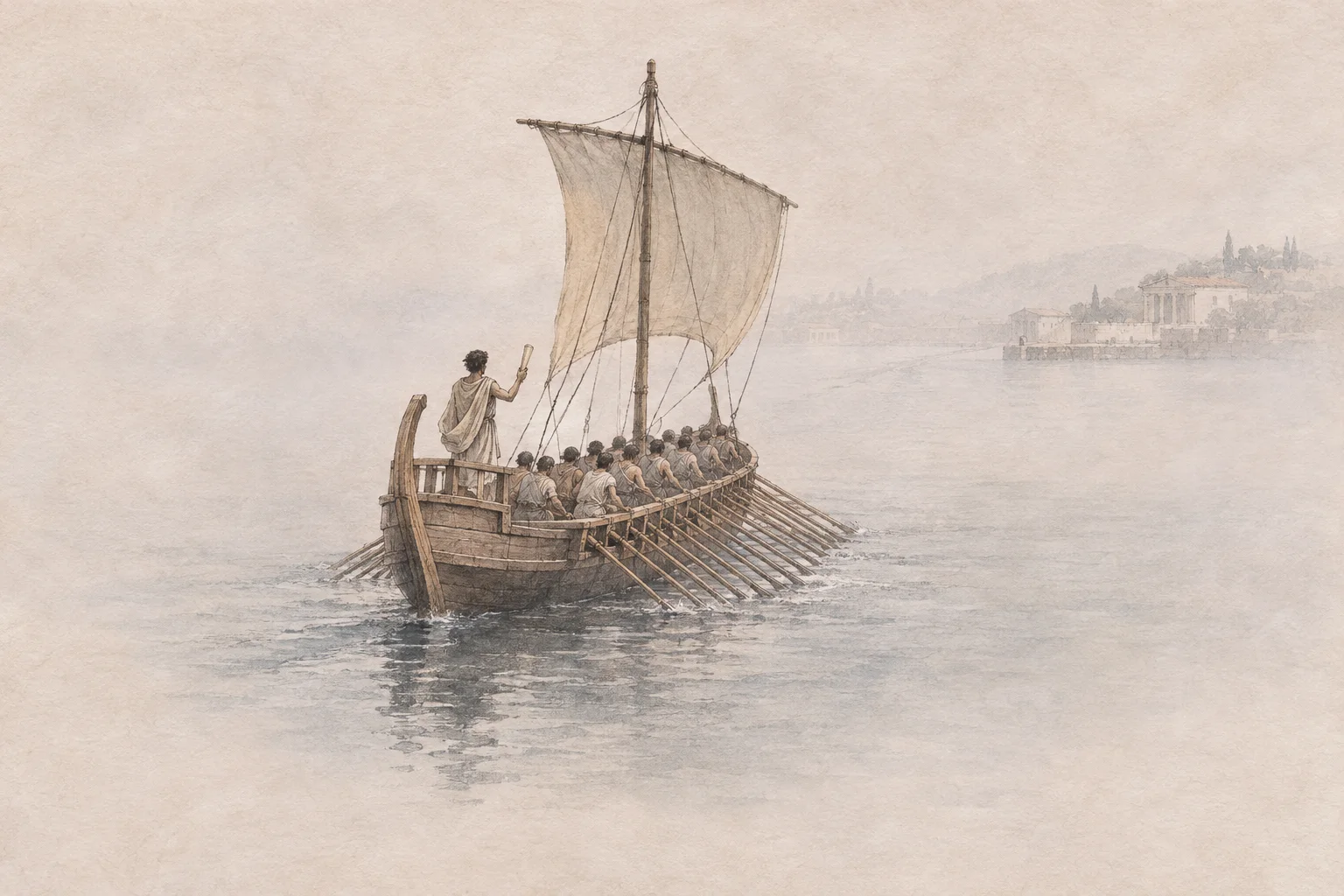
The records are thinner on the carrier: they assign roles and cycles but do not say why any role would hurry. The second galley was rowed by men fed and promised rewards by the people facing the danger. Nothing in the records corresponds to that motive, except perhaps the ombudsman, whose office exists to carry families' complaints, and a synthetic record is unlikely to be able to show such a motive at all.
On luck the records are silent. A document that wrote in a fair wind would be a plan of the kind Clarke describes, one that could not work as written.
7.2Collingridge and Clarke after the galley
The Mytilenean episode supports Collingridge's position in one respect and complicates it in another. The reversal was possible only because the first decree had not been carried out: corrigibility existed for one night and was used. Yet the correction was decided correctly and nearly failed anyway. A decision can be corrigible in principle and still not corrected in time, if the signal cannot travel faster than the act. Collingridge's note speaks of decisions easy to monitor and to correct; Thucydides' narrative adds that the correction must also arrive.
The episode bears on Clarke's position more obliquely. The second decree was an order, not a plan for a catastrophe, but it relied on things it did not write: the crew's motives, the first ship's slowness and the wind. That suggests an extension of Clarke's test which the note itself does not make: a promise of correction should be judged not only by whether it could work as written but by what it relies on and leaves unwritten.
The two records can be judged that way. The first record relies, without fully writing it, on logs that would show the bias the challenger fears, and on a processing deadline not yet agreed. Its own judgments name both reliances. The second record relies on families being able to report errors, and its outcome auditor names that reliance too. Neither record hides what it depends on. Nothing Clarke is cited for here reaches the question of whether fantasy documents name their reliances, so the contrast settles nothing. But the records are written by AI under a format that asks for unknowns and objections, and naming a reliance is not the same as removing it.
7.3Who rows: risk and danger
Luhmann's distinction runs through all three texts. At Athens the first decree was a risk to the assembly and a danger to Mytilene, and the reconsideration began with, and the galley was provisioned by, those who faced the danger. In the first record, exposure of movement data is a danger to residents and a risk to the board; in the second, the wait is a danger to families and the caution is the committee's risk.
What none of the three texts does is give the stop to those who face the danger. At Mytilene, the envoys could ask for a second vote and pay for a fast crew, but the decision was the assembly's. In the records, residents and families can object and complain, and their complaints may trigger reopening, but the trigger is confirmed by a role in the deciding system. Diodotus' remark about responsibility applies: advisers answer for their advice and the assembly does not, and if those who advised and those who decided suffered alike, the assembly would judge more calmly. The records do not make the deciders suffer alike. They do, in places, make the deciders count.
7.4What the evidence can and cannot carry
The Mytilenean episode is one story, told by one historian, read here in one nineteenth-century translation. It cannot show how often reversals succeed or what conditions are necessary in general. It can show one case in which the conditions are visible, which is why it was chosen.
The records are synthetic. Their boards and committees do not exist, and their judgments were generated by AI from the record alone, so the agreement of the thirteen says something about the generator. The care with which the records write their stops says something about the platform's form, which gives every record a decider, a deadline and reopening lines. The parent study's ledger found conditions for revisiting in every record, and its program found a number, a threshold or a time in most of them; but the program cannot see a role or an event, and the reading of the reopening lines in Sections 5.5 and 6.4 is one the program does not make. The appendix gives the figures.
Nothing in this article bears on real ceasefires, real verification boards or real records of the missing. Fortna's finding about verification and the durability of ceasefires was used only to suggest why the setting of the first record might make records matter; the finding is not tested here.
7.5Alternative readings
Three other readings deserve mention. One puts the weight of the episode on the two speeches rather than the voyage; that is compatible with this reading, since the speeches set out the positions that the voyage tests. Another reads the second galley as compassion arriving in time; the article has only noted that Diodotus, as Crawley renders him, argued from interest, and that the crew were moved by rewards. A third holds that the records' care with stops is an artefact of the platform's format. That is partly right. But a form that asks for reopening lines produces documents of which the question of what would trigger them can be asked, which is how this article was able to ask it.