8.1Contribution
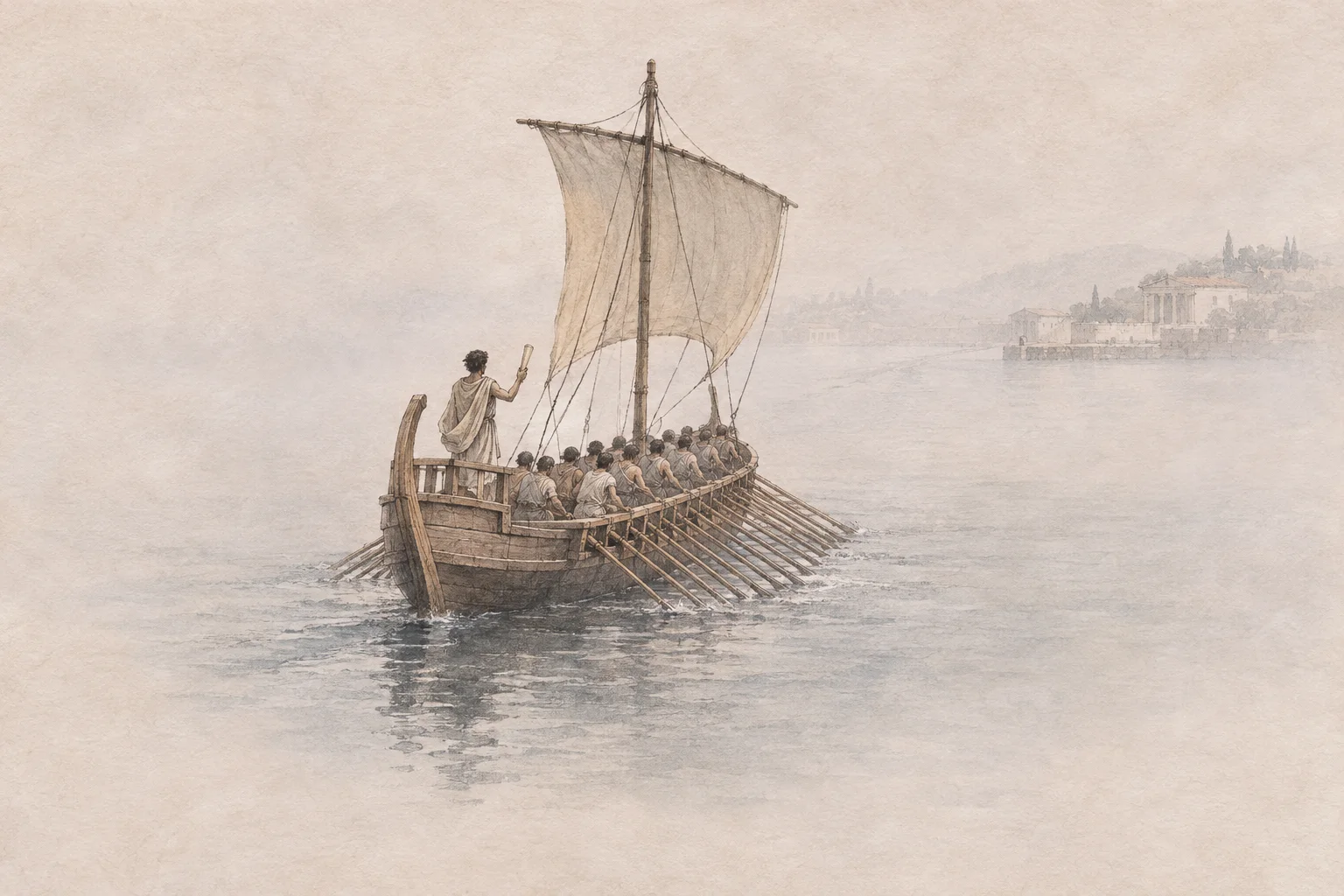
This article asked what makes an order to stop observable rather than merely written. It read the Mytilenean episode in Book III of Thucydides as a narrative about the interval between decision and execution, and drew from it five conditions under which a reversal took effect: a known head start, a motivated carrier, a reader at the far end, an act not yet done, and luck. It set those conditions beside Collingridge's case for corrigible decisions and Clarke's account of plans that could not work as written but serve to persuade, and proposed two extensions: that corrigibility depends on the correcting signal reaching the point of execution in time, and that a promise of correction should be judged by what it relies on and does not write.
Read with those conditions, the two synthetic Meridian records write a stop before the act at a known hour and pass it through a reader, the structure the second galley lacked and had to make up by rowing. They assign carriers and cycles to their reopening conditions but leave most triggers to the carrier's judgment. One writes a count an outsider could check and calls it a proposal. Neither conceals what it relies on.
8.2Limits
The primary text was read in a single English translation of 1874, and the readings of its speeches are this article's; a reader working from the Greek or another translation may weigh Cleon's and Diodotus' words differently. The records are modern summaries written by AI for the platform, about fictional polities, with no outcomes. Their judgments agree with one another because they were generated from the same record. The secondary works were used narrowly, as Section 1.3 states. The five conditions are drawn from one episode and may not hold elsewhere. The article offers no view on which option either record should choose; the decisions belong to the people who would make them.
8.3Further research
Three lines of work would test the argument. The first would read other classical accounts of reversed or recalled orders, where the study's rules allow, to see whether the five conditions recur. The second would read the reopening lines of the full collection of defence records with a test that can see roles and events as well as numbers, to ask how many name a trigger someone outside the role could check. The third, which no synthetic record can serve, would compare written stop conditions in real institutions with the occasions on which they were used, to learn whether the carrier's motive, which Thucydides makes decisive and the records leave unwritten, matters as much outside the story as inside it.
Appendix: ledger figures used
The figures below are taken from the parent study's numbers.md and, for the two cases, from its ledger.json, in the ledger's own terms. The coders are two models of different families.
Collection-wide (numbers.md):
| Count | Value |
|---|---|
| Cases | 50, all synthetic |
| Cases with a condition for revisiting the judgment (A5) | 50 of 50 (100%) |
| Conditions in all | 798 |
| of which in judgments[].claims.stopConditions | 650; with a number, a threshold or a time 602 |
| of which in decisionBrief.reopenWhen | 148; with a number, a threshold or a time 27 |
| Conditions stated with a number, a threshold or a time (the code cannot see an event or a role) | 629 of 798 (79%) |
| Conditions whose wording is 30% or more the studio's frame | 0 of 798 |
| Cases whose published judgments chose more than one option (A7) | 13 of 50 |
| decider cell, coders agree | 28 of 50 (56%) |
| bearer cell, coders agree | 42 of 50 (84%) |
| reversal action: impossible (implied) | 4 |
| H2, strict and lenient | against (supports 0, against 50, unclear 0, not applicable 0; share 0%) |
| H1, strict | supports (supports 25, against 0, unclear 25, not applicable 0; share 100%) |
| H1, lenient | supports (supports 42, against 0, unclear 8, not applicable 0; share 100%) |
| H4, lenient | supports (supports 30, against 0, unclear 7, not applicable 13; share 100%) |
Observation records keeper (meridian:FSP-DEF-CEASEFIRE-02), from ledger.json:
| Cell or field | Value |
|---|---|
| A7 selected options | 1 distinct of 13 |
| decisionBrief.reopenWhen, observable flag | false for each of the three lines |
| decider | unsettled (team-or-organisation, stated; institution-or-state, stated) |
| bearer | those-nearest-the-stoppage, settled (implied; stated) |
| horizon | days-to-months (implied) |
| reversal constraint | unsettled (easy, implied; costly, implied) |
| reversal action | impossible (implied) |
| place | unsettled (human-decides, stated; human-approves, stated) |
| H1 | strict unclear; lenient supports |
| H4 | strict not applicable; lenient supports |
Missing-person record conflicts (meridian:FSP-DEF-TRUST-02), from ledger.json:
| Cell or field | Value |
|---|---|
| A7 selected options | 1 distinct of 13 |
| decisionBrief.reopenWhen, observable flag | false for each of the three lines |
| decider | unsettled (team-or-organisation, stated; institution-or-state, implied) |
| bearer | those-nearest-the-stoppage (stated) |
| horizon | unsettled (days-to-months, implied; unknown) |
| reversal constraint | easy (implied) |
| reversal action | costly (implied) |
| place | human-decides (stated) |
| H1 | strict supports; lenient supports |
| H4 | strict not applicable; lenient supports |
In plain words: both coders read what the first decision lets happen as impossible to undo, and what the second lets happen as costly to undo; in both records they found the cost of waiting falling on those nearest the stoppage. The program did not flag any of the three reopening lines in either record, though it flagged most of the judgments' stop conditions.