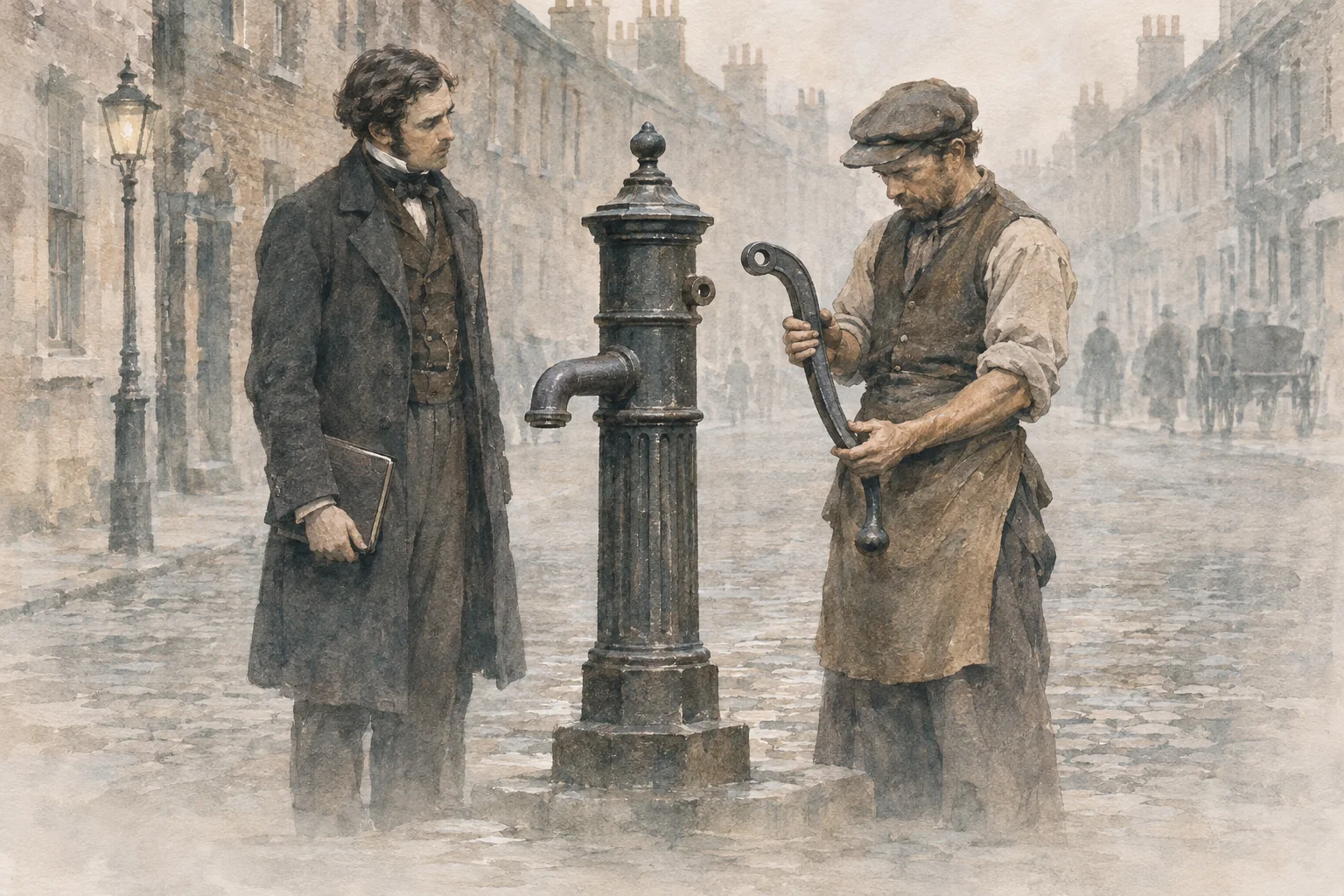
The historical claim of this section is that the removal of the Broad Street pump handle was obtained by a short, local inquiry presented in person to a local authority, at a moment when the evidence that would have shown the act's effect could not exist, and that Snow's own account says so. For the debate, the section sets the actor's text beside Vinten-Johansen and colleagues' reading: three of their four points about the handle can be found in Snow's words in the passage he printed in 1855, while the fourth, the water-company comparison, lies outside that passage. It also asks whether the alliance thesis, framed for Pasteur, finds anything to hold on to in a case where the authority acted within a day.
4.1The scale and the flight
Snow opens the account with its magnitude and its place: "The most terrible outbreak of cholera which ever occurred in this kingdom, is probably that which took place in Broad Street, Golden Square, and the adjoining streets, a few weeks ago. Within two hundred and fifty yards of the spot where Cambridge Street joins Broad Street, there were upwards of five hundred fatal attacks of cholera in ten days."
The phrase "a few weeks ago" places the writing close to the event, although the book that carries it is dated 1855, and the count is an estimate ("upwards of") bounded by a radius from a street corner.
Snow then names the force that would complicate every later reading of the outbreak's course: "The mortality would undoubtedly have been much greater had it not been for the flight of the population." He describes who left first and how, and ends: "so that in less than six days from the commencement of the outbreak, the most afflicted streets were deserted by more than three-quarters of their inhabitants."
The flight returns later in the account as the reason a complete inquiry became impossible. It is both a fact about the outbreak and a limit on the evidence.
4.2Days of inquiry
The account of what Snow did before he went to the Board is short and precise about its own hesitation: "As soon as I became acquainted with the situation and extent of this irruption of cholera, I suspected some contamination of the water of the much-frequented street pump in Broad Street, near the end of Cambridge Street; but on examining the water, on the evening of the 3rd September, I found so little impurity in it of an organic nature, that I hesitated to come to a conclusion. Further inquiry, however, showed me that there was no other circumstance or agent common to the circumscribed locality in which this sudden increase of cholera occurred, and not extending beyond it, except the water of the above mentioned pump."
The order is worth keeping. Snow began with a suspicion. The first test he applied, an examination of the water, did not support it. He then turned to a different kind of evidence, the absence of any other common factor, which is an argument by elimination rather than by direct detection. Read for the present debate, the sentence shows the evidence at the moment of the act to be inferential from the start: the water did not look guilty, and the case against it rested on the failure of every other candidate.
He then went to the registers. He obtained, at the General Register Office, a list of the cholera deaths registered in three sub-districts during the week ending 2 September, and found that most had fallen on the last two days of the week. His inference about the start is stated as his own: "I considered, therefore, that the outbreak commenced on the Thursday; and I made inquiry, in detail, respecting the eighty-three deaths registered as having taken place during the last three days of the week."
What the inquiry found is reported in two steps. First, the map of the deaths against the pumps: "On proceeding to the spot, I found that nearly all the deaths had taken place within a short distance of the pump. There were only ten deaths in houses situated decidedly nearer to another street pump." Of those ten, Snow says, five families always sent to Broad Street because they preferred its water, and three of the dead were children who went to school near the pump; the remaining two he treats as the background of cholera already present before the outbreak.
Second, the drinking: "With regard to the deaths occurring in the locality belonging to the pump, there were sixty-one instances in which I was informed that the deceased persons used to drink the pump-water from Broad Street, either constantly or occasionally. In six instances I could get no information, owing to the death or departure of every one connected with the deceased individuals; and in six cases I was informed that the deceased persons did not drink the pump-water before their illness."
The source of each datum is a family or a household of the dead. "I was informed" occurs twice in two sentences. This is evidence by report, gathered on the spot within days, and Snow marks it as such. The cases he could not resolve are counted and left in, not dropped.
His conclusion from it is a sentence about where the outbreak was not: "The result of the inquiry then was, that there had been no particular outbreak or increase of cholera, in this part of London, except among the persons who were in the habit of drinking the water of the above-mentioned pump-well."
4.3The meeting and the act
Then comes the act, in two sentences: "I had an interview with the Board of Guardians of St. James’s parish, on the evening of Thursday, 7th September, and represented the above circumstances to them. In consequence of what I said, the handle of the pump was removed on the following day."
These are the only words in the passage about the decision. They say who was persuaded, when, by what ("the above circumstances", the inquiry just described) and what followed. They do not say who on the Board spoke, whether there was dissent, or what else the Board considered. "In consequence of what I said" is Snow's claim about the cause of the Board's decision, not a record of the Board's reasons.
The first of Vinten-Johansen and colleagues' points, that Snow persuaded the Board, is thus in the actor's text, resting on the actor's own statement. That is a limit for both sides of the debate. The evidence side can say what Snow presented; it cannot show that the Board acted because the evidence was good rather than because removing a handle was cheap, quick and easily undone. The alliance side can note that one physician, appearing in person, obtained an act within a day; it cannot show from this text what interests the Board's members brought to the meeting.
What Snow brought on the evening of the seventh was an answer produced in days, under the pressure of an epidemic, from incomplete records and second-hand reports. That is close to what Jasanoff describes as the science used for regulation, which must produce answers under time pressure and uncertainty, although her subject is twentieth-century American regulation and not a London parish.
4.4What was not yet known
Snow is direct about what his inquiry had not covered. Beyond the eighty-three deaths, he says, many others in the same days were registered late or occurred in hospitals, and he could not trace them all: "I should have been glad to inquire respecting the use of the water from Broad Street pump in all these instances, but was engaged at the time in an inquiry in the south districts of London, which will be alluded to afterwards;" When he returned to the neighbourhood two or three weeks later, the remaining population had dispersed so far that a complete account was impossible.
The south London inquiry he mentions in passing is the water-company comparison that the reading note on his book calls his stronger evidence. Inside the Broad Street passage it appears only as the reason the local inquiry was left unfinished: the act on the pump and the stronger argument for the theory competed, in his own account, for the same days.
Snow then makes the inference that the limited inquiry has to bear: "There is no reason to suppose, however, that a more extended inquiry would have yielded a different result from that which was obtained respecting the eighty-three deaths which happened to be registered within the district of the outbreak before the end of the week in which it occurred." The phrase "happened to be registered" concedes that the sample was selected by the timing of registration, not by design.
4.5The exceptions
Snow then turns to the exceptions, which he presents as strengthening the case. Three bear on this article's question, because each brings a named person or institution into the evidence.
The first is the workhouse: "The Workhouse in Poland Street is more than three-fourths surrounded by houses in which deaths from cholera occurred, yet out of five hundred and thirty-five inmates only five died of cholera, the other deaths which took place being those of persons admitted after they were attacked. The workhouse has a pump-well on the premises, in addition to the supply from the Grand Junction Water Works, and the inmates never sent to Broad Street for water."
The second is the brewery near the pump, where none of the workmen were registered among the dead. Snow went to the proprietor, and the evidence is the proprietor's word: "The men are allowed a certain quantity of malt liquor, and Mr. Huggins believes they do not drink water at all; and he is quite certain that the workmen never obtained water from the pump in the street."
The third is the case Snow ranks highest. He introduces it through the physician who brought it to him: "Dr. Fraser also first called my attention to the following circumstances, which are perhaps the most conclusive of all in proving the connexion between the Broad Street pump and the outbreak of cholera." A widow living at West End, Hampstead, died of cholera on 2 September, as the registrar's weekly return recorded. Snow's evidence for how she was exposed came from her son: "I was informed by this lady’s son that she had not been in the neighbourhood of Broad Street for many months. A cart went from Broad Street to West End every day, and it was the custom to take out a large bottle of the water from the pump in Broad Street, as she preferred it." A niece visiting her also drank the water and also died, in a part of Islington where, Snow says, there was no cholera at the time.
Read for the alliance question, these paragraphs are a list of guarantors. The workhouse's water arrangements, the brewer's assurance about his men's habits, a physician's referral and a son's account of his mother's preference each carry part of the argument, and each is attached to a person or an institution Snow names. Read for the evidence question, the same paragraphs are a natural comparison: places and people near the pump who did not drink from it, and people far from it who did. Both readings are available in the same sentences. The text does not choose between them; it does both things at once.
The same holds for the smaller cases. Of seven workmen of a dentists' materials manufactory, Snow relies on a surgeon of Greek Street, Mr. Marshall: "He learned that they were all in the habit of drinking water from the pump, generally drinking about half-a-pint once or twice a day;" Middlesex Hospital's books, the superintendent of the works, a manufacturer, a microscopist and the Registrar-General supply much of the rest. As printed, the account's evidence runs through a network of named informants rather than beside one, although some of them, the account makes plain, reported after the meeting of 7 September: the well was opened, and the fuller inquiry attempted, only later.
This article draws the vocabulary of alliance from Latour's note, which concerns Pasteur, not Snow; whether it fits a London physician's informants is this article's question, not Latour's claim.
4.6The table and its rule
The account then turns from cases to a count. Table I, as Snow prints it, gives for each day from 19 August to 30 September the number of fatal attacks and the number of deaths. Its construction is explained in a paragraph that is, in effect, a rule of counting. Snow had the exact hour of attack for upwards of eighty deaths in Middlesex Hospital, from its books, and in a few other cases; for the rest: "In a few other cases also I had exact information of the hour of attack, and in the remainder I have calculated it by subtracting the duration of the illness from the date of death. Where the illness did not exceed twelve hours, the attack was considered to have commenced the same day; where the illness exceeded twelve, and did not exceed thirty-six hours, the attack was put down to the previous day, and so on."
He assesses the rule himself: "Although this plan does not always give the precise date of attack, it reaches within a few hours of it," and he names the cases it could not reach: "There are forty-five cases in which the duration of the illness was not certified, or entered in the books of the registrars, and the time of attack in these cases is consequently unknown."
The table's day of attack is therefore a computed quantity, and the rule that computes it is printed beside it. Porter's argument that rules for counting let a claim reach beyond a community of trust offers one way to read this: Snow does not ask the reader to trust his dating of the attacks, he gives the rule by which anyone could repeat it. That is this article's use of Porter's lens, not something Porter says of Snow, and the other half of Porter's argument, which ties such rules to weak or contested experts, finds no support in the passage itself.
4.7The decline in Snow's own words
The paragraph that bears most directly on the debate comes right after the table. Snow states the fall of the attacks before the handle was removed, day by day: "The greatest number of attacks in any one day occurred on the 1st of September, immediately after the outbreak commenced. The following day the attacks fell from one hundred and forty-three to one hundred and sixteen, and the day afterwards to fifty-four. A glance at the above table will show that the fresh attacks continued to become less numerous every day. On September the 8th—the day when the handle of the pump was removed—there were twelve attacks; on the 9th, eleven; on the 10th, five; on the 11th, five; on the 12th, only one; and after this time, there were never more than four attacks on one day. During the decline of the epidemic the deaths were more numerous than the attacks, owing to the decease of many persons who had lingered for several days in consecutive fever."
And then his judgment on what the decline means for the act: "There is no doubt that the mortality was much diminished, as I said before, by the flight of the population, which commenced soon after the outbreak; but the attacks had so far diminished before the use of the water was stopped, that it is impossible to decide whether the well still contained the cholera poison in an active state, or whether, from some cause, the water had become free from it."
This sentence is the actor's own statement of two of Vinten-Johansen and colleagues' points: the outbreak was declining before the handle came off, and its author did not claim that the removal ended it. It goes further. It says that whether the well was still dangerous on the eighth cannot be decided, and it names two causes of the fall that have nothing to do with the handle: the flight, and the possibility that the water had, "from some cause", become free of the poison.
The sentence also separates the time of the act from the time of the evidence. On the evening of the seventh, Snow could not have known the counts for the eighth through the twelfth. The fall he describes was assembled afterwards, from hospital books and registrars' returns, by the rule of the previous paragraph. The decision was taken on the evidence of the inquiry; the evidence that would have judged the decision arrived later and did not judge it.
4.8The physical evidence that was missing
Snow then reports a test that failed to support him. The well was opened: "The pump-well has been opened, and I was informed by Mr. Farrell, the superintendent of the works, that there was no hole or crevice in the brickwork of the well, by which any impurity might enter; consequently in this respect the contamination of the water is not made out by the kind of physical evidence detailed in some of the instances previously related."
This is a second admission of the kind made on 3 September: direct evidence of contamination was absent. What remained was the water's character as users observed it, a microscopist's report of organic particles, and a householder's account of an offensive smell on 2 September. On the source of the impurity Snow is conditional: "Whether the impurities of the water were derived from the sewers, the drains, or the cesspools, of which latter there are a number in the neighbourhood, I cannot tell." His conclusion that earlier patients' evacuations reached the well is reached by "judging the matter by the light derived from other facts and considerations previously detailed, we must conclude that such was the case." Those facts lie in the earlier parts of the book; the local case leans on the general theory as much as it supports it.
4.9The rival explanations
The account closes by weighing other explanations. Snow states the strength of his own: "Whilst the presumed contamination of the water of the Broad Street pump with the evacuations of cholera patients, affords an exact explanation of the fearful outbreak of cholera in St. James’s parish, there is no other circumstance which offers any explanation at all, whatever hypothesis of the nature and cause of the malady be adopted." He then disposes of the rivals: disturbed drains, which a report to the commissioners had found not borne out by the streets that suffered; a supposed plague pit; and the smell of the sewers: "There is nothing peculiar in the sewers or drainage of the limited spot in which this outbreak occurred; and Saffron Hill and other localities, which suffer much more from ill odours, have been very lightly visited by cholera."
The rivals are explanations by place and environment; Snow's is an explanation by a specific matter carried from the sick to the well. In Rosenberg's terms, configuration stands against contamination. That is this article's reading through Rosenberg's distinction, not Rosenberg's claim about Snow. What matters for the debate is that Snow decides the contest by comparing places, which is the kind of evidence the notes say his stronger case also was.
4.10Who died
One paragraph bears on who bore the outbreak: "The greatest portion of the persons who died were tailors and other operatives, who worked for the shops about Bond Street and Regent Street, and the wives and children of these operatives. They were living chiefly in rooms which they rented by the week." Many buried at the parish's expense, Snow adds, "were far from being paupers, and would on any other occasion have been buried by their friends,"
These sentences name who bore the outbreak. They cannot name who bore the interval between its start on the night of 31 August and the act of 8 September, because in Snow's table the act came after the peak.
4.11The record beside the text
Skeptron's record of the case condenses the account into a scenario of several sentences. Its second sentence gives the fact that Snow's own paragraph gives:
Snow wrote that after the September 1 peak the number of new outbreak cases was already declining, and that on September 8, when the handle was removed, there were 12 cases.
The record's twelve cases on 8 September are the twelve attacks of Snow's text and of his table; the record calls them cases where Snow calls them fatal attacks. The record adds a sentence that is easy to pass over:
The dates of death and of onset also did not match.
Snow's table keeps attacks and deaths in two columns, and he explains why they diverge during the decline ("the deaths were more numerous than the attacks") and how onset was computed. The record's sentence is a modern warning that two counts in one table measure different moments; Snow's paragraph is the reason for it.
On the boundary of judgment, the record asks the question this article's debate turns on:
May the effect size of the removal measure be back-calculated while ignoring the point at which the decline began?
Its answer:
Population outflow and the decline before the removal must be considered together. Snow himself wrote that it was difficult to determine with certainty whether the source of infection remained in the well at the time the water was stopped.
The answer keeps both of Snow's qualifications: the flight and the prior decline. Its second sentence softens Snow's wording slightly. Snow wrote that it was "impossible to decide" whether the well still held the poison; the record says it was "difficult to determine with certainty". The difference is small, but it runs in one direction: the actor's statement of his own uncertainty is stronger than the modern summary's.
What the record leaves out is as telling as what it keeps. It mentions neither the Board of Guardians nor any of Snow's informants. Its source is a modern archive page, not the book. A reader who knew Broad Street only from the record would know the count and its limit, and would not know who had to be persuaded or by whose testimony. For the evidence and alliance debate, the record keeps the evidence side and drops the alliance side entirely.
4.12What this case adds
The section began from the claim that the handle was removed after a short, local inquiry presented in person, on a curve already falling, and that Snow's own account says so. The text bears this out. To Vinten-Johansen and colleagues' reading it adds the actor's sentences for three of their four claims (the fourth, the water-company comparison, lies outside the passage, which mentions that inquiry only in passing), and one statement stronger than theirs: that whether the well was still dangerous on the day of the act was impossible to decide. To the debate as a whole it adds that Snow's evidence, as printed, is woven from named people's reports, so that what the debate sorts into evidence and alliance is here one fabric. To the alliance thesis it offers a case in which a local authority acted within a day on evidence that, by its author's account, could not show the act's effect; the text does not say a network of interested allies moved the Board, and it does not rule that out.