6.1Who had to be persuaded, and when
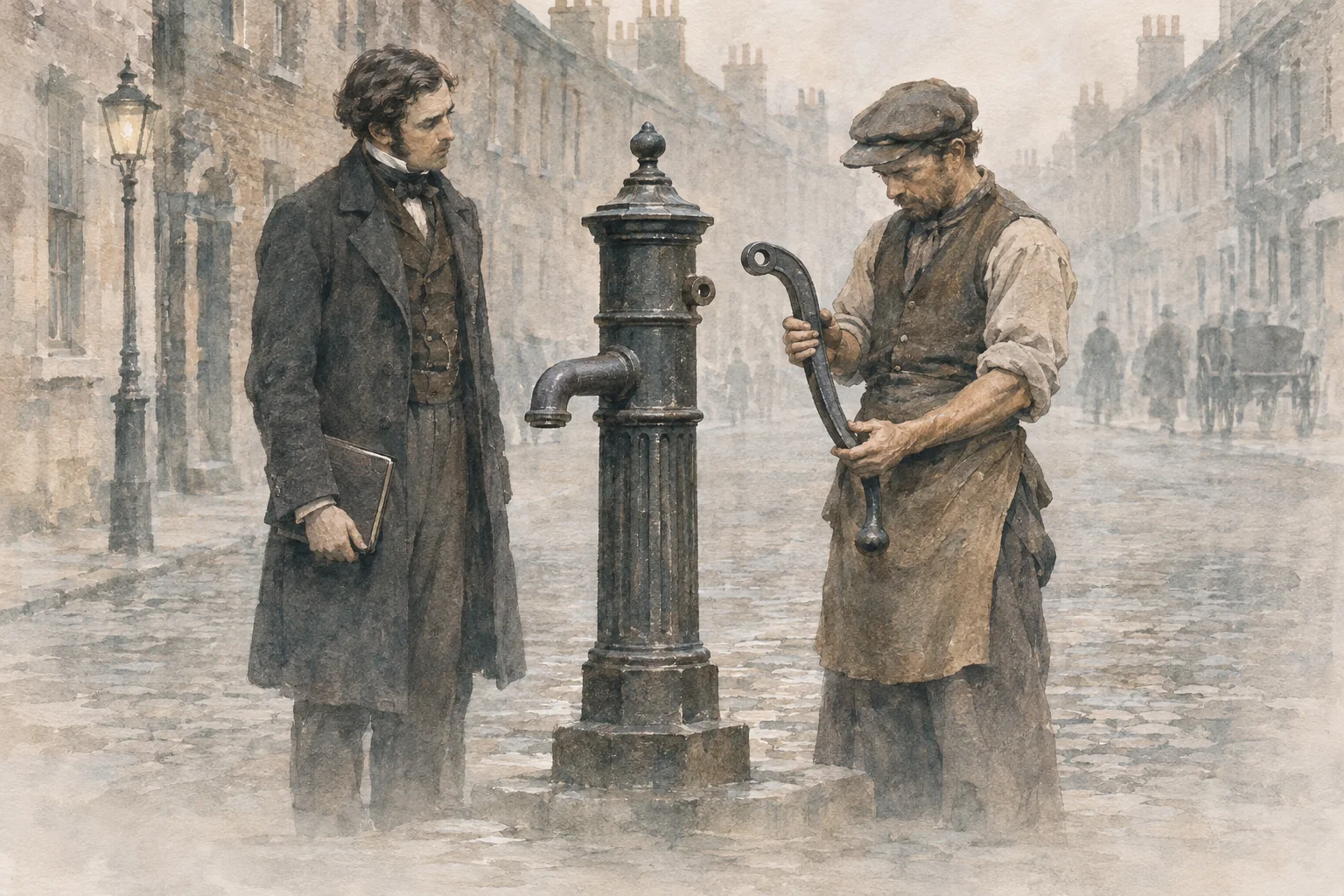
The two acts had different audiences, and the difference shapes what counts as winning. Snow had to persuade a parish board to do one cheap and reversible thing, quickly, before anyone could know what would follow; the text says nothing of who the board's members were. Pasteur, in July, had no authority to persuade in the same sense: the report presents the decision to treat as his own, taken after two physicians had judged the boy's danger, and is silent on anyone else's consent. The audience his report had to persuade was the Académie, in October, with three months and three weeks of the boy's good health in hand. The Broad Street text records a decision under uncertainty, told afterwards with the uncertainty intact. The Meister report records one told afterwards with the result known and the uncertainty moved to the method's mechanism and to the question of delay.
6.2What the act itself could prove
In neither case could the act prove its own effect. Snow says so in a sentence. Pasteur's report concedes it by its structure: the boy's survival is set beside the fifty dogs and the control inoculation, never offered alone, and the working of the method is left for later communications. This shared feature is easy to miss, because Geison's argument concerns what preceded the act and Latour's what followed it. A reader who wants to say that either act was won by its evidence has to locate that evidence before the act: in Snow's inquiry and its exceptions, in Pasteur's dogs. A reader who wants to say that either was won by alliance has to show that the allies, not the evidence, moved the deciders. The reports allow the first claim to be examined in detail. They allow the second to be noticed but not proved, since neither records the reasons of those who were persuaded.
6.3Evidence and alliance in the same sentences
The finding this article offers is that, in the actors' own texts, evidence and alliance are not two things to be weighed against each other. They are the same sentences. Snow's evidence for the pump, as printed, is a son's account of his mother's preference, a brewer's assurance about his men, a surgeon's inquiry into seven workmen, a hospital's admission books: each a datum and each a guarantor. Pasteur's evidence for the treatment is the fifty dogs, which he describes, and the bitten dogs, which the Rabies Commission had seen; where the described evidence stops, a body of witnesses takes its place.
Both sides of the debate can use that observation, and the article leaves it so. A reader with Geison can say that a report which puts witnesses where a described test should be is exactly what a check against the notebooks is for. A reader with Latour can say that a report which builds its evidence from named allies is exactly how a fact is made to hold. What the reports rule out is a reading in which either act was won by evidence that stood without allies, or by allies who stood without evidence.
Porter's lens suggests one difference between the reports. Snow prints the rule by which his attack dates were computed, so that a reader can check his count without trusting him. Pasteur prints a protocol for dogs, but the claim on which the act rests, success on bitten dogs, is backed by witnesses rather than by a rule or a count. At the point where Snow's report reached for the kind of distance Porter attributes to rules, Pasteur's reached for a commission. Neither report says why its author chose as he did.
6.4What the modern summaries keep and what they add
Skeptron's two records keep the limits the actors drew: the decline before the removal and Snow's doubt about the well; the fact that Meister's case is one person's record. Each adds a modern caution in the same spirit. On the evidence side of the debate, the summaries are careful.
They drop the alliance side in both cases. Neither mentions the Board of Guardians, the Académie, the Rabies Commission or any named informant or witness. And one record names a person the actor's report leaves unnamed: Grancher, as the one who began the vaccination, a name drawn from the institute's account of 2015. The record states its source, but a reader who meets the name there cannot tell that the report of the time did not give it. The two records also stand at different distances from the actors: the Broad Street record cites an archive page of Snow's own book, the Meister record a later institutional account.
6.5What the evidence cannot carry
Several limits bound everything above. Snow is quoted and Pasteur paraphrased, because the only available text of Pasteur's paper is an uncorrected machine reading; any phrase of Pasteur's that matters, above all in the paragraph about the dogs, should be checked against the page images. Both reports are the actors' own accounts, written after the act, and neither records the reasons of those persuaded; the alliance thesis cannot be confirmed or refuted from documents that do not record the allies' motives. The decisive secondary evidence lies outside the texts read here: Geison's notebooks, used only as his note gives them, and Snow's water-company comparison. Some lenses are stretched: Latour's note concerns Pasteur, not Snow; Marks's the United States after 1900; Jasanoff's twentieth-century American regulation. Where this article has read Snow through Latour or Rosenberg, or the Board's decision through Jasanoff, it has said that the reading is its own.
Nothing here says that either act was right or wrong. The boy lived; the attacks fell; neither fact, by its actor's own account, shows what the act did. Whether a parish board should have removed a handle on a few days' evidence, or a scientist should have treated a boy on evidence from unbitten dogs and a commission's witness, are questions the reports raise and leave to the reader.