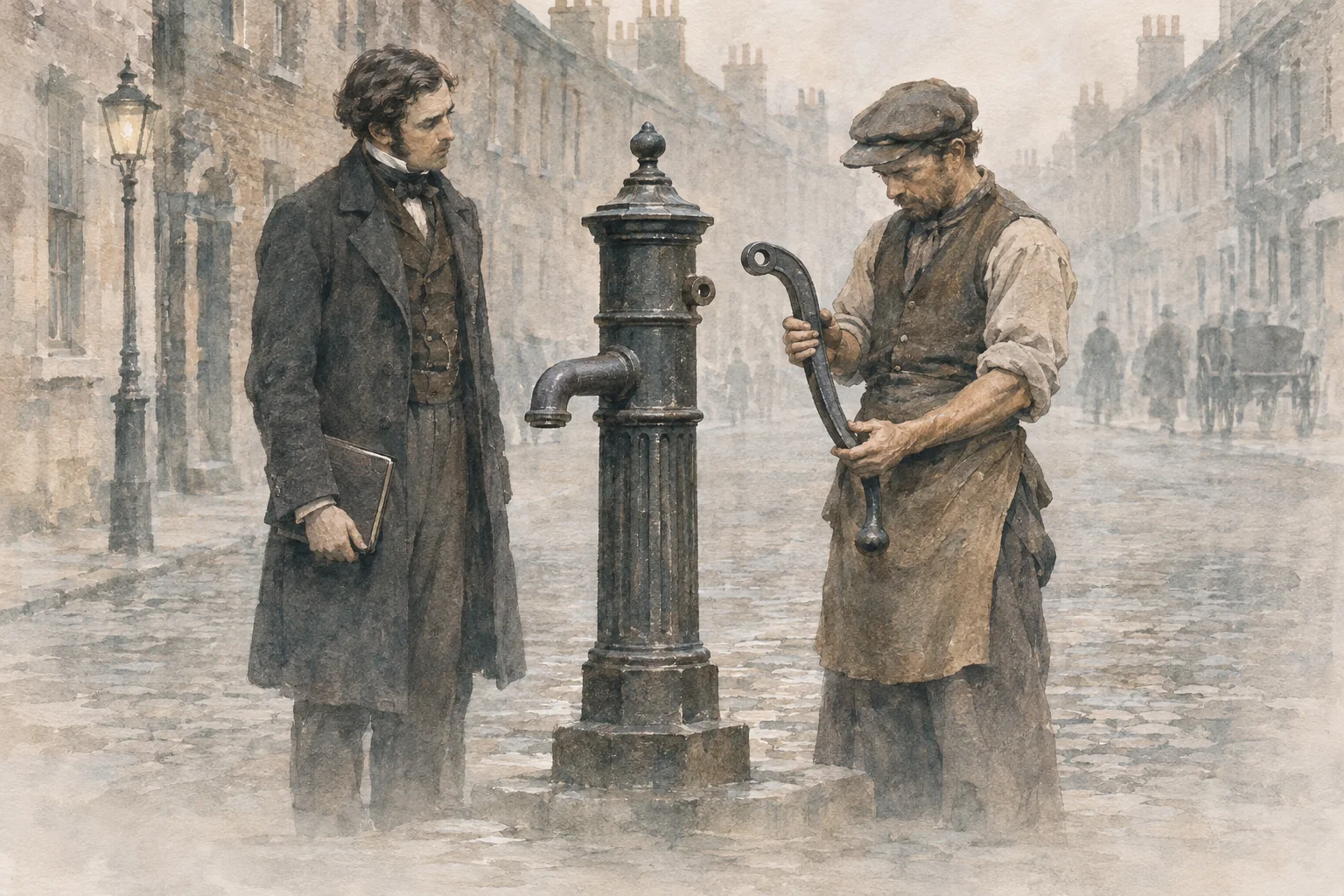
On the evening of Thursday, 7 September 1854, a physician who had spent the previous days inquiring into the deaths around Golden Square in Soho went before the Board of Guardians of St James's parish and told them what he had found. The next day the handle of a public pump in Broad Street was taken off. On the evening of Monday, 6 July 1885, in a laboratory in Paris, a boy from Alsace who had been bitten two and a half days earlier by a rabid dog received under the skin of his side half a syringe of a preparation of rabbit spinal cord that had been drying for fifteen days. Over the next ten days he received more. He did not develop rabies.
Both acts can be told as stories in which a man with evidence persuaded an authority to act. Both have also been retold, in later scholarship, as stories in which the evidence was weaker, or differently placed, than the first telling allowed. In Snow's case the doubt is about timing: the outbreak was already in decline when the handle came off. In Pasteur's case it is about what had been tested before the boy was treated, and about how the method came to be accepted.
This article asks a single question of the two acts. Were they won by evidence, or by the alliances around the men who argued for them? Put differently: when an authority acted (a parish board in 1854, a scientist with two physicians at his side in 1885), what did the person urging the act have to show, and whose presence made the showing count?
The question joins a known debate. On one side stands Gerald Geison's reading of Pasteur's private laboratory notebooks, which argues that Pasteur's public accounts differed from his private research, and in particular that before treating Joseph Meister he had not tested on dogs bitten by rabid animals the particular series of inoculations he used on the boy, contrary to what his published report led readers to believe (Geison 1995). On the other side stands Bruno Latour's account of Pasteur's successes as the work of alliances, in which hygienists, physicians, veterinarians, the army and others took up the microbe because it served their own projects, and laboratory results were made to hold outside the laboratory by extending its conditions into farms and hospitals (Latour 1988). Geison asks whether the evidence was what the report said it was; Latour asks how results came to hold at all.
Snow's case enters through the scientific biography by Peter Vinten-Johansen, Howard Brody, Nigel Paneth, Stephen Rachman and Michael Rip, which shows that Snow persuaded the parish Board of Guardians to remove the handle, that the outbreak was already declining when it was removed, that Snow himself did not claim the removal ended the outbreak, and that his case rested more on the comparison of households supplied by different water companies; the book also traces how slowly the medical establishment accepted his theory (Vinten-Johansen and others 2003).
The contribution of this article is to read the two actors' own reports, Snow's second edition of 1855 and Pasteur's paper to the Académie of 26 October 1885, as evidence for both sides of that debate at once, and to set beside each the modern summary that Skeptron, a history studio of the RISCON family, wrote of the case for its platform. Each report names the people who saw, vouched for or assisted in the work, at the points where the argument most needs them. Each describes an act whose own effect could not be read from what followed it, and says as much. That makes both documents awkward for a story of evidence alone and for a story of alliance alone. The article does not decide between the two; it shows what each report gives each side, and where the page stops.
Section 2 lays out the debate. Section 3 describes the texts, the platform records and the study from which this article is drawn. Section 4 reads Snow's account of Broad Street; Section 5 reads Pasteur's report on Meister. Section 6 brings them together, and Section 7 states the contribution and its limits.