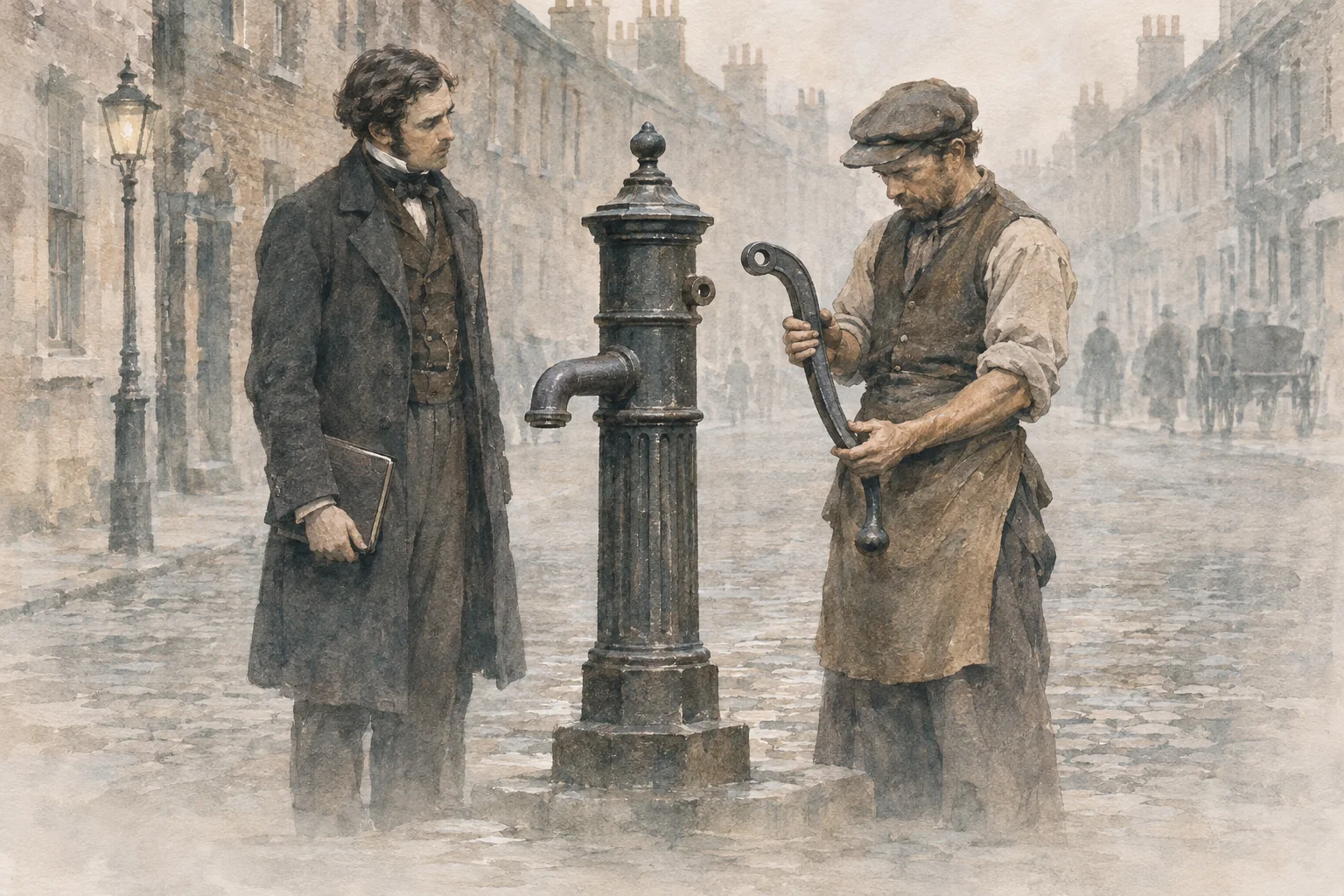
This article asked whether two famous acts on disease, the removal of the Broad Street pump handle in 1854 and the treatment of Joseph Meister in 1885, were won by evidence or by the alliances around the men who urged them. It read the actors' own reports, Snow's at length in his words and Pasteur's in close paraphrase, beside the modern summaries a history platform wrote of each, and against the debate between Geison's notebook-based critique and Latour's account of facts that hold through networks, with Vinten-Johansen and colleagues' reading of Snow as the matching case.
Its contribution is threefold. First, it shows that the reports themselves contain the material on which both sides of the debate draw, and that this material sits in the same sentences: in Snow's exceptions, where each datum is also a guarantor; in Pasteur's paragraph on the dogs, where the concession that the fifty dogs were unbitten is followed directly by an appeal to a commission's witness. Second, it shows that both actors refused, in their own words or in the structure of their reports, to let the outcome of the act stand as proof of the act's effect; Snow's judgment that the question was "impossible to decide" is stronger than the modern summary of it. Third, it shows that the modern platform summaries keep the evidential limits and drop the alliances, and in one case name an actor the report of the time does not.
The limits are those of Section 6.5: an uncorrected French text that cannot be quoted, reports that do not record the reasons of those persuaded, secondary arguments that rest on documents this article has not read, and lenses that fit some cases loosely.
Further research could proceed in three directions. The first is to read the page images of Pasteur's paper and quote it properly, especially the paragraph on the dogs, and to set it beside the notebook entries Geison cites. The second is to read Snow's water-company comparison in the same way as the Broad Street passage, asking whether its evidence is likewise built from named informants or whether it is, as Porter's lens would lead one to look for, carried more by rules of counting. The third is to look for any surviving record of the St James's Board of Guardians for the evening of 7 September 1854, which alone could say what the board thought it was deciding, and on whose word.
Appendix: the ledger's values for the two cases
The values below are the parent study's, as the two codings gave them, for the records of the two cases. A value of unsettled would mean the two codings differed; for these two cases they did not differ on any of the cells shown.
| Case | act | act kind | act before proof | gap named | count | bearer named | revision in case |
|---|---|---|---|---|---|---|---|
| The Broad Street Pump | yes | restriction-of-movement-work-or-assembly | yes | named | settled | not-named | named |
| Pasteur and Joseph Meister | yes | trial-or-treatment | yes | named | qualified-by-definition-scope-or-denominator | not-named | named |
Agreement between the two codings across all 89 cases, for the cells above: act 75 of 89 (84%); act kind 74 of 89 (83%); act before proof 69 of 89 (78%); gap named 76 of 89 (85%); count 78 of 89 (88%); bearer named 70 of 89 (79%); revision in case 67 of 89 (75%).
Among the 23 cases the parent study reads closely, act kind was trial-or-treatment for 3 and restriction-of-movement-work-or-assembly for 5; count was settled for 2 and qualified-by-definition-scope-or-denominator for 5; bearer named was not-named for 13.
The study's own first hypothesis (E1: in most cases that show a public act, the act was taken before the cause it addressed, or its own effect, was established) was read as unclear on the strict reading (supports 8, against 3, unclear 61, not applicable 17; share 73%) and as supported on the lenient reading (supports 25, against 5, unclear 20, not applicable 39; share 83%). Its fifth (E5: in most cases that show a public act, the case's own text does not name who bore the harm or the cost while the act waited) was read as unclear strict (supports 17, against 6, unclear 49, not applicable 17; share 74%) and supported lenient (supports 21, against 9, unclear 20, not applicable 39; share 70%). In Skeptron's medicine history (17 cases), E5 was supported strict (6 for, 3 against, 8 unclear; 67%) and lenient (9 for, 4 against, 4 unclear; 69%).
The parent study's test of whether a record lets a later reader judge an act in its own time (a public act; a named gap between the event and its record; who bore the wait named; what would change the reading named) passed in 1 of 36 cases (3%); among the 23 cases the study reads closely, 1. From the cells in the table above, neither of these two cases meets all four conditions: in both, bearer named is not-named.