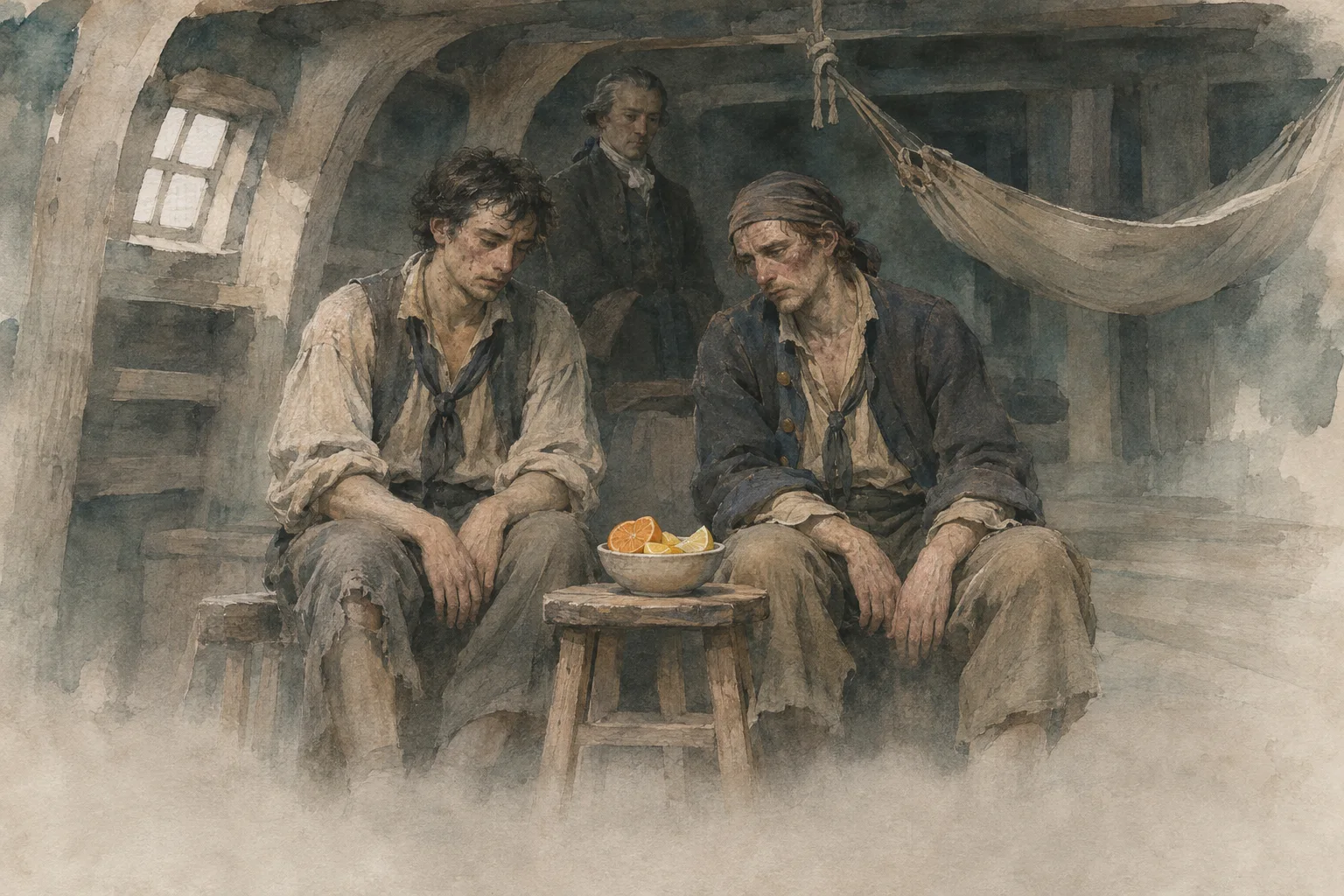
2.1Discipline against judgment
Marks's account of the controlled trial is a history of distrust. In his telling, therapeutic reformers did not trust the individual physician to judge whether a remedy worked, and they did not trust the claims made by those who sold remedies. Their answer was to discipline therapeutic knowledge by collective, controlled experiment, and the randomised trial's authority, on this reading, was not won by a single demonstration but built over decades (Marks 1997). The book's subtitle confines it to the United States between 1900 and 1990. It is used here as a lens on two British reports from the eighteenth century, which is a stretch; the stretch is part of the test, since a lens that fits badly shows where the earlier documents differ from what the later discipline required.
Two things follow from Marks's account for the reading of Lind and Jenner. The first is that the authority of an early trial report should rest on the reporter, since the collective structures that would later underwrite a trial did not yet exist. The second is that the gap between what a trial showed and what its reporter claimed should be wide and unpoliced, since policing that gap is exactly what the later discipline was for.
2.2Numbers, trust and who vouches
Porter's argument about quantification approaches the same question from the side of numbers rather than experiments. Rules for counting and calculating, in his account, are a technology of distance: they let a claim travel beyond a community whose members trust one another. Mechanical objectivity, following rules rather than judgment, is pursued most by experts who are weak or contested and by bureaucracies under outside pressure, as a substitute for the personal trust that secure elites can rely on (Porter 1995).
Rusnock's history of vital accounts brings the turn to numbers into the eighteenth century itself. Physicians and others in England and France, she shows, used the bills of mortality and new tallies to settle medical and political questions, among them whether smallpox inoculation was worth its risk, by comparing deaths from natural and inoculated smallpox. The trust such accounts won depended on how the numbers were gathered and on who vouched for them (Rusnock 2002).
Side by side with Marks, these two accounts make the disagreement sharper. Marks sees the trial's authority as late, collective and born of distrust. Rusnock sees numerical arbitration of a medical question already at work in Jenner's century, and on a question, the risk of smallpox inoculation, that this article reads as close to the one Jenner's Inquiry addresses. Porter predicts that the actor who turns to rules is the one whose standing is weak. A reader of the two reports can ask which of these patterns the texts follow: whether they argue from counts or from cases, and whether the author who was refused a hearing argues differently from the one who was not.
2.3What a single case can carry
A second debate concerns the single case. Jenner's Case XVII is one boy. Lind's citrus arm is two men, of whom one recovered within six days. Bent Flyvbjerg's essay on case-study research answers what he calls five misunderstandings, among them the belief that one cannot generalise from a single case and the belief that case studies are biased towards confirming what the researcher already thinks (Flyvbjerg 2006). Alexander George and Andrew Bennett set out kinds of case study, among them the plausibility probe, a preliminary study that asks whether an untested idea is worth fuller testing, and the method of structured, focused comparison, which asks the same questions of each case (George and Bennett 2005).
These works pull against Marks. Where the reformers in his account distrusted the individual case reported by the individual physician, Flyvbjerg defends what such a case can do, and George and Bennett give a name, the plausibility probe, to a study whose purpose is to justify a larger one. The question for the two reports is whether they present themselves as proofs or as probes. That is a question about the authors' own words, and it can be answered from them.
2.4Acting before the proof
The two trials also sit inside a debate about acting before evidence is complete. Cass Sunstein argues that a strong precautionary principle is incoherent, because precaution against one risk creates others and risks lie on all sides of a decision; he recommends weighing costs and benefits with margins of safety (Sunstein 2005). The editors of Late Lessons from Early Warnings, writing from case studies prepared for the European Environment Agency, collect hazards for which early warnings were available long before action was taken, and draw lessons that include acknowledging ignorance as well as uncertainty and keeping up long-term monitoring of early warnings (Harremoës and others 2001).
Neither work is about the eighteenth century, and neither is about remedies. Their use here is to frame the two acts that followed the trials. Lind's report was followed, by Kenneth Carpenter's account, by decades in which the British navy did not issue lemon juice routinely, until 1795 (Carpenter 1986). That interval looks like one of the late lessons. Jenner's report, by Stefan Riedel's account, was followed by the rapid spread of vaccination (Riedel 2005). Jenner's case for it was itself a comparison of risks: the known dangers of smallpox inoculation against the dangers he had not seen from cowpox. That is Sunstein's ground, risks on all sides.
Richard Neustadt and Harvey Fineberg's study of the 1976 swine influenza programme adds a further distinction. They trace overconfidence built on thin evidence, the merging of separate decisions into one, and the absence of planned points at which a decision would be looked at again; they recommend asking what would change a decision (Neustadt and Fineberg 1978). Neustadt and Ernest May, in Thinking in Time, propose that decision makers separate what is known, what is unclear and what is presumed about a situation (Neustadt and May 1986). That three-way sorting is the reading tool this article uses on each report: what the trial showed, what the author marked as uncertain, and what the author presumed.
2.5The histories of the two cases
Two histories supply what the reports cannot say about their aftermath. Carpenter's history of scurvy holds that Lind's trial showed oranges and lemons best but that Lind did not conclude citrus was a specific remedy; Lind held to a theory of scurvy as a disorder of digestion and perspiration and recommended a concentrated, boiled juice, the rob, that lost much of its virtue; the navy issued lemon juice routinely from 1795; the later substitution of West Indian limes, less potent, led to setbacks; and the cause of scurvy was settled only in the twentieth century with vitamin C (Carpenter 1986). Riedel's overview of Jenner holds that inoculation with smallpox matter, variolation, had been practised in Asia and Africa and brought to England in the 1720s; that Jenner's inoculation of May 1796 followed country observations that milkers who had had cowpox escaped smallpox; that the Royal Society did not accept his first report of 1797; and that he published the Inquiry privately in 1798 (Riedel 2005).
Both histories bear on the question of claims. Carpenter's account implies that Lind's report claimed less than later readers drew from it. Riedel's implies that Jenner's report had already failed once to persuade the body whose approval mattered most, and was printed without it.