The historical claim of this section is that Lind's chapter, read in full, reports a comparison whose flaws it largely discloses, and that its widest claims are hedged in the author's own words; the claim that citrus was a specific remedy for scurvy, which Carpenter says Lind did not draw, is not made in this chapter either. For the debate, the section adds a first test of Marks's account: Lind's authority rests entirely on his own person, as Marks's history would expect, but the policing of the gap between trial and claim that Marks assigns to a later discipline is partly done, in this chapter, by the reporter himself.
4.1The trial as Lind describes it
Lind dates the trial to 20 May 1747 and places it aboard the Salisbury at sea. He took twelve patients in the scurvy and says their cases were as similar as he could make them: all, in general, had putrid gums, the spots, lassitude and weakness of the knees. They lay together in one place, a part of the fore-hold set aside for the sick, and they shared one diet. Lind lists it in detail: water-gruel sweetened with sugar in the morning; fresh mutton broth often for dinner, and at other times puddings, boiled biscuit with sugar and the like; and for supper barley and raisins, rice and currants, sago and wine, or something similar (Lind 1753, pp. 191–196).
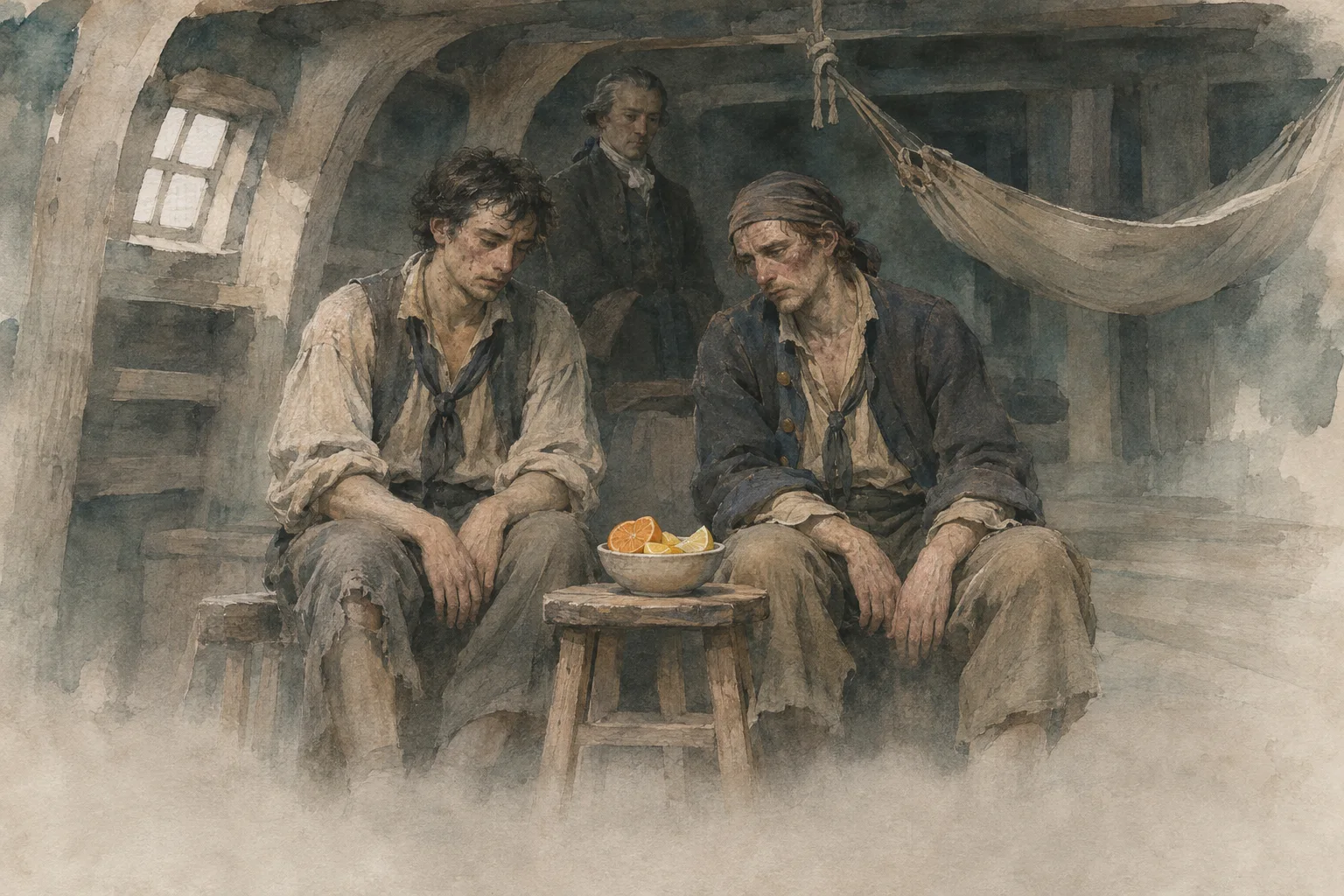
The six treatments follow, two men to each. Two were ordered a quart of cider a day. Two took twenty-five drops of elixir of vitriol three times a day on an empty stomach, and used a gargle strongly acidulated with it. Two took two spoonfuls of vinegar three times a day on an empty stomach, with their gruel, their other food and their gargle acidulated with vinegar as well. Two, described by Lind as the worst patients, with the tendons in the ham rigid (a symptom, he notes, that none of the rest had), were put on a course of sea water, half a pint a day, sometimes more or less as it worked, as a gentle purge. Two had two oranges and one lemon given them every day, which they ate greedily at different times on an empty stomach; they continued only six days on this course, having consumed the quantity that could be spared. The last two took, three times a day, a portion of an electuary the size of a nutmeg, made of garlic, mustard seed and other drugs and recommended by a hospital surgeon, with barley water acidulated with tamarinds to drink; a decoction of tamarinds with cream of tartar purged them gently three or four times during the course.
The result comes in Lind's order. The most sudden and visible good effects were seen from the oranges and lemons. One of the two who had taken them was fit for duty at the end of six days. Lind adds at once that the spots were not quite gone from his body nor his gums sound at that time, but that with no other medicine than a gargle of elixir of vitriol he became quite healthy before the ship reached Plymouth, on 16 June. The other was the best recovered of any in his condition and, now thought pretty well, was appointed nurse to the rest of the sick.
Next to the oranges, Lind thought, the cider had the best effects. He says the cider was not very sound, being inclined to be sour. Even so, those who took it were in a fairer way of recovery than the others at the end of the fortnight, which was the length of every course except the oranges; the putrefaction of their gums, and especially their lassitude and weakness, were somewhat abated, and their appetite increased.
Of the elixir of vitriol, Lind observed that the mouths of those who used it as a gargle were cleaner and in better condition than many of the rest, especially those who used vinegar, but he saw no other good effect from taking it inwardly. He then reaches outside the trial. He had never had a great opinion of the medicine, he says, since the Salisbury's longest cruise, from 10 August to 28 October 1746, when there was only one case of scurvy in the ship: a marine who, after recovering from an ague in late September, had taken elixir of vitriol as a restorative for three weeks and yet contracted the disease while on a medicine recommended for its prevention.
There was no remarkable change in those who took the electuary and tamarinds, the sea water or the vinegar, when their condition at the end of the fortnight was compared with that of others who had taken nothing but a little mild laxative electuary and cream of tartar now and then to keep the bowels open, or a gentle remedy for the chest in the evening. One of the vinegar pair fell into a gentle flux at the end of ten days, which Lind attributed to the nature and course of the disease rather than to the medicine. He closes by saying that he will discuss the effects of other medicines elsewhere, and that the result of all his experiments was that oranges and lemons were the most effectual remedies for the distemper at sea. He is inclined to think oranges preferable to lemons, though perhaps both given together will be found most serviceable.
4.2What the trial could show
Read with Neustadt and May's sorting in mind, the chapter divides clearly. The trial as described could show that, among twelve men chosen to be alike and kept alike in place and diet, the pair given oranges and lemons improved faster than the other five pairs over the period each was observed. It could show this only for two men, one of whom was fit for duty in six days, and for a measure that Lind gives in words: the state of the gums, the spots, lassitude, weakness, appetite, and fitness for duty.
Lind's own account discloses several ways in which the comparison was not even. The citrus pair was observed on its treatment for six days, the others for a fortnight, because the fruit ran out; the arms did not run for the same time. The sea-water pair were, by Lind's description, the two worst patients and had a symptom none of the others had; the pairs were not alike at the start, and at least one pair was placed by its severity. The cider was not sound, so the second-best arm was a spoiled version of its own treatment. And the comparison that judged the electuary, the sea water and the vinegar ineffective was made against others, apparently not among the twelve, who had taken only mild laxatives, and whom the chapter does not describe further.
None of these is hidden. They appear in the same paragraphs as the results, often in the same sentence. A reader of 1753 who wished to discount the trial had what was needed to do so in Lind's own words.
4.3What Lind marked as uncertain
Several of Lind's statements carry their own hedge. The cider, he thought, had the next-best effects; the statement is given as his judgment, not as a measured difference. The flux in the vinegar pair he attributed to the disease rather than the remedy, again as an attribution. And the sentence on oranges and lemons that ends the passage is the most hedged of all: he says he is inclined to think oranges better than lemons, and that both together may well serve best.
That last sentence is worth a closer look, because it is the place where the chapter goes furthest beyond its design. No arm of the trial received oranges alone or lemons alone. The citrus pair had two oranges and one lemon every day. The trial could not have distinguished the effect of an orange from that of a lemon, and Lind does not say that it did. His preference for oranges is put as an inclination, in a phrase that signals leaning rather than finding. The guess that both together will serve best is put with a word of doubt, and it is in fact the only combination the trial tested, though only against the other five treatments and not against either fruit alone.
4.4What Lind claimed beyond the trial
The claims that run past the trial without a hedge sit in particular sentences, and they can be taken one at a time.
The first is the general conclusion: that the result of all his experiments was that oranges and lemons were the most effectual remedies for the distemper at sea. Because Lind speaks of all his experiments, the sentence reaches beyond the twelve sailors, to work he says he will describe elsewhere, and so it is not a summary of this trial alone. Within the chapter it rests on one pair. The restriction to the sea limits its scope, and the superlative is comparative, not a claim of cure. As claims go, it is bounded; but it is a general conclusion from a pair.
Next comes the verdict on elixir of vitriol, which leans on one marine from the cruise of 1746. Lind's low opinion of the medicine is supported in his text by a single case outside the trial, a man who took the remedy as a restorative and fell ill anyway. That is a case report, not a comparison, and it is used to explain a negative result within the trial.
The last sits in footnote (g), the letter from Ives, who treated the scurvy on another ship. Ives reports that on a cruise of the western squadron under Admiral Martin he gave each scorbutic patient on the Yarmouth, a ship of 70 guns and 500 men, a quart or three pints of cider daily, and some of them sea water twice a week. Other ships, he writes, buried a great many, some 20, others 30, 40, 50 and upwards, while the Yarmouth buried no more than two or three, and those at the end of the cruise after the cider had run out a week or ten days before. Ives himself says he claims no more than a palliative benefit from cider and sea water, and that he will not mention particular cases. But his letter states, as something known from experience, that vegetable juices of all sorts were the only true antiscorbutics. The figures in the letter are burials per ship without any count of the sick in the other ships or of their treatment, and the comparison is between ships, not patients. Lind prints it as supporting evidence. Its claim rests on Ives's own account of a past cruise.
4.5The record beside the text
Skeptron's record compresses the trial into two sentences:
The 1753 publication states that on 20 May 1747 twelve patients sharing the same location and basic diet were compared in pairs across six kinds of treatment. It reported the rapid improvement of the group given citrus fruit.
Both sentences are faithful to Lind's chapter as far as they go. What they leave out is instructive. The record's "group given citrus fruit" was two men, observed on the fruit for six days because the supply ran short; the record does not say that the arms ran for unequal times. It says nothing of the sea-water pair's greater severity, or of the spoiled cider. A reader of the record alone would learn that the trial was a paired comparison with a shared setting and diet, which is true, and would not learn the ways in which, by Lind's own account, the pairs were not alike.
On the question of design, the record is careful in the other direction. Its third question sets the trial beside the later method directly:
May this small comparison trial be treated as equivalent to modern large-scale randomized trials?
Its answer:
Evidence of allocation randomization or blinding cannot be added arbitrarily. The recorded comparison, the 1753 publication, and the later naval supply policy are examined separately.
The record declines to supply what Lind did not report. Lind's text supports a stronger statement than the record makes: for at least one pair, the allocation was not random but by severity, since the two worst patients were the ones put on sea water. The record's caution is a refusal to invent; the chapter itself provides positive evidence on the point.
The second sentence of that answer draws the distinction that Carpenter's history requires. The trial of 1747, the publication of 1753 and the navy's later supply policy are three different events. Carpenter places routine issue of lemon juice in 1795, decades after the trial, and records that Lind himself recommended a boiled concentrate that lost much of its virtue and held to a theory in which scurvy was a disorder of digestion and perspiration (Carpenter 1986). The reading note on the Treatise adds that the work as a whole sets the trial within that broader theory and reviews earlier writers, and does not present citrus as a sole or specific cure (Lind 1753). The record keeps these apart in one more sentence:
The publication knowledge of 1753 is not inserted as already disclosed information on the trial start date.
For the article's question, this separation matters. Whatever Lind claimed, he claimed in 1753, not in the fore-hold in May 1747. And whatever was later claimed for him, the chapter does not say. A trial that the platform's own record measures against modern randomized trials is reported, in its own chapter, with a general conclusion bounded to the sea, a preference put as an inclination, and a set of disclosed irregularities that a careful reader could use against it.
4.6What this case adds
For the debate set out in Section 2, Lind's chapter gives a mixed result. Marks's account is right about the source of authority: the chapter rests on Lind's person, in the first person throughout, with no procedure that a reader could check independently of his say-so, and with a supporting letter that rests on another surgeon's memory. Nothing in it resembles the collective, controlled experiment Marks describes. But the chapter does not show the unpoliced gap that the account might lead a reader to expect. Its widest claims are hedged or bounded, its irregularities are stated in the open, and the largest leap, from a pair to a general remedy, is made by appeal to all his experiments, which points beyond the trial to evidence the reader is promised elsewhere. Rusnock's numerical culture is barely visible: the trial's outcome is told in words, and the only counts are Ives's burials per ship. The study's ledger reads the record as showing an act taken before its effect was established, and as not naming what later finding would change the reading. On the evidence of the chapter, the claims Lind made were narrower than the place later given to the trial. Whether they were narrower than the trial could bear is the question the next case sharpens.