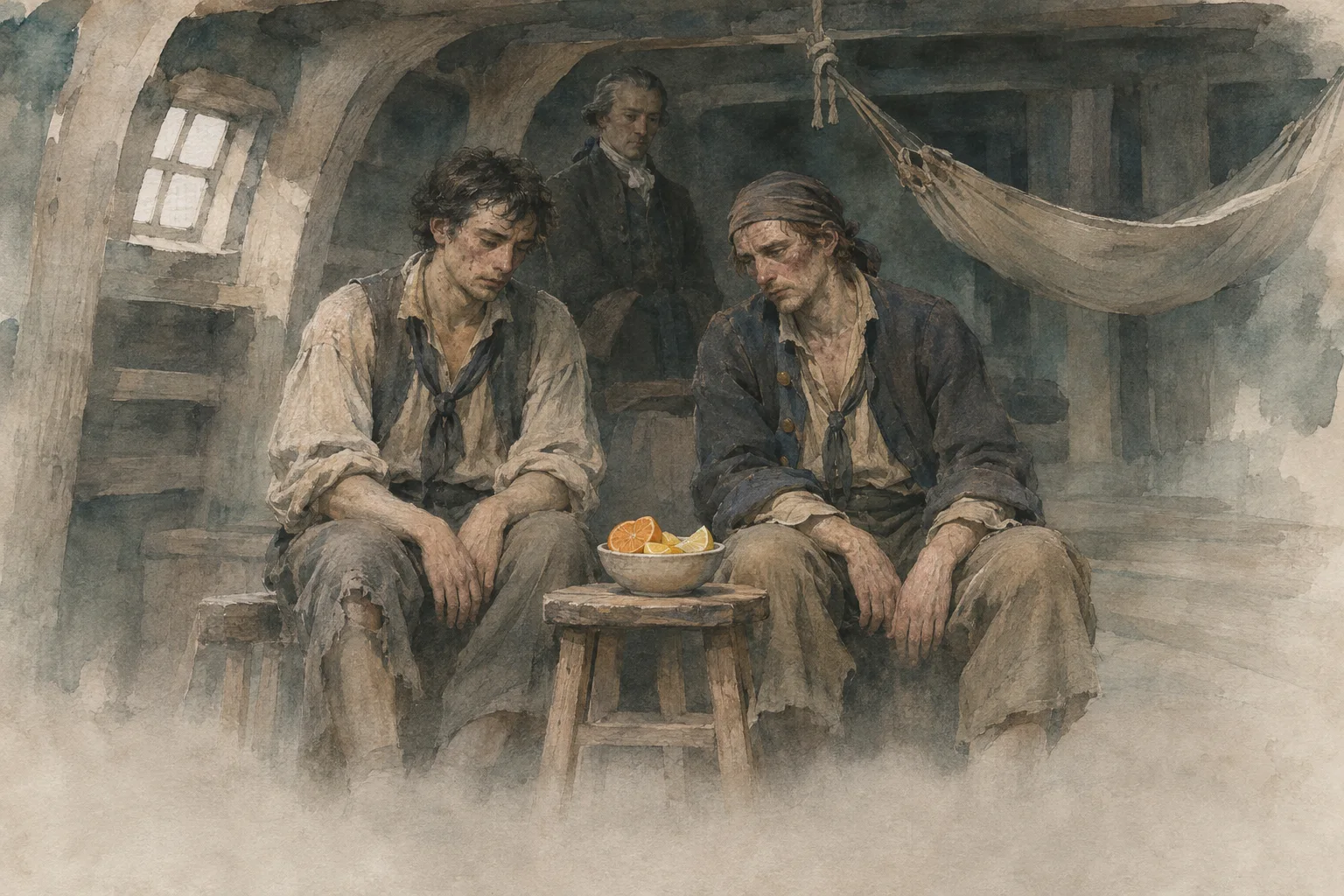
This study is an expansion by AI of 2 records published by Skeptron, a studio in the RISCON family, and of the public-domain source texts listed below. Every sentence in a block quote is word for word either a record's own or a passage of a source text saved with this study, and its source line names which; the rest is AI writing. Skeptron's records are modern summaries of historical episodes written for a platform, not archival documents; they keep some of what the actors wrote and drop the rest, and the paper says which where it matters. The readings through the works named are this study's interpretation. Nothing in this study is advice on medical, public-health or policy decisions.
| Case | Studio | Record |
|---|---|---|
| Lind's Twelve Sailors | Skeptron | https://skeptron.risconlabs.com/questions?question=HQ-HC2-LIND1747-01 |
| Jenner's Inquiry | Skeptron | https://skeptron.risconlabs.com/questions?question=HQ-HC2-JENNER1796-01 |
The source texts this study read are saved with it, and the passages it quotes from them stand in them word for word:
| Text | File | Address |
|---|---|---|
| James Lind, A Treatise of the Scurvy (1753), Part II, Chapter IV ("Of the prevention of the scurvy"): the trial on the Salisbury, May 1747, and its results | sources/lind-treatise-scurvy-1753.md | https://archive.org/download/b30507054/b30507054_djvu.txt |
| Edward Jenner, An Inquiry into the Causes and Effects of the Variolae Vaccinae (1798): the dedication and opening pages, Cases XVII and XVIII (the cow-pox inoculation of May 1796, and John Baker, 1798), and the closing pages | sources/jenner-inquiry-1798.md | https://www.gutenberg.org/cache/epub/29414/pg29414.txt |
The records were read on 2026-10-06. The texts were fetched on 2026-10-06. This study was written on 2026-10-07.
Bibliography
- James Lind, A Treatise of the Scurvy (1753).
- Edward Jenner, An Inquiry into the Causes and Effects of the Variolae Vaccinae (1798).
- Richard E. Neustadt and Harvey V. Fineberg, The Swine Flu Affair: Decision-Making on a Slippery Disease (1978).
- Richard E. Neustadt and Ernest R. May, Thinking in Time: The Uses of History for Decision Makers (1986).
- Kenneth J. Carpenter, The History of Scurvy and Vitamin C (1986).
- Stefan Riedel, Edward Jenner and the History of Smallpox and Vaccination (2005).
- Andrea A. Rusnock, Vital Accounts: Quantifying Health and Population in Eighteenth-Century England and France (2002).
- Theodore M. Porter, Trust in Numbers: The Pursuit of Objectivity in Science and Public Life (1995).
- Cass R. Sunstein, Laws of Fear: Beyond the Precautionary Principle (2005).
- Poul Harremoës and others, Late Lessons from Early Warnings: The Precautionary Principle 1896–2000 (2001): European Environment Agency, Environmental issue report No 22.
- Harry M. Marks, The Progress of Experiment: Science and Therapeutic Reform in the United States, 1900–1990 (1997).
- Alexander L. George and Andrew Bennett, Case Studies and Theory Development in the Social Sciences (2005).
- Bent Flyvbjerg, Five Misunderstandings About Case-Study Research (2006).