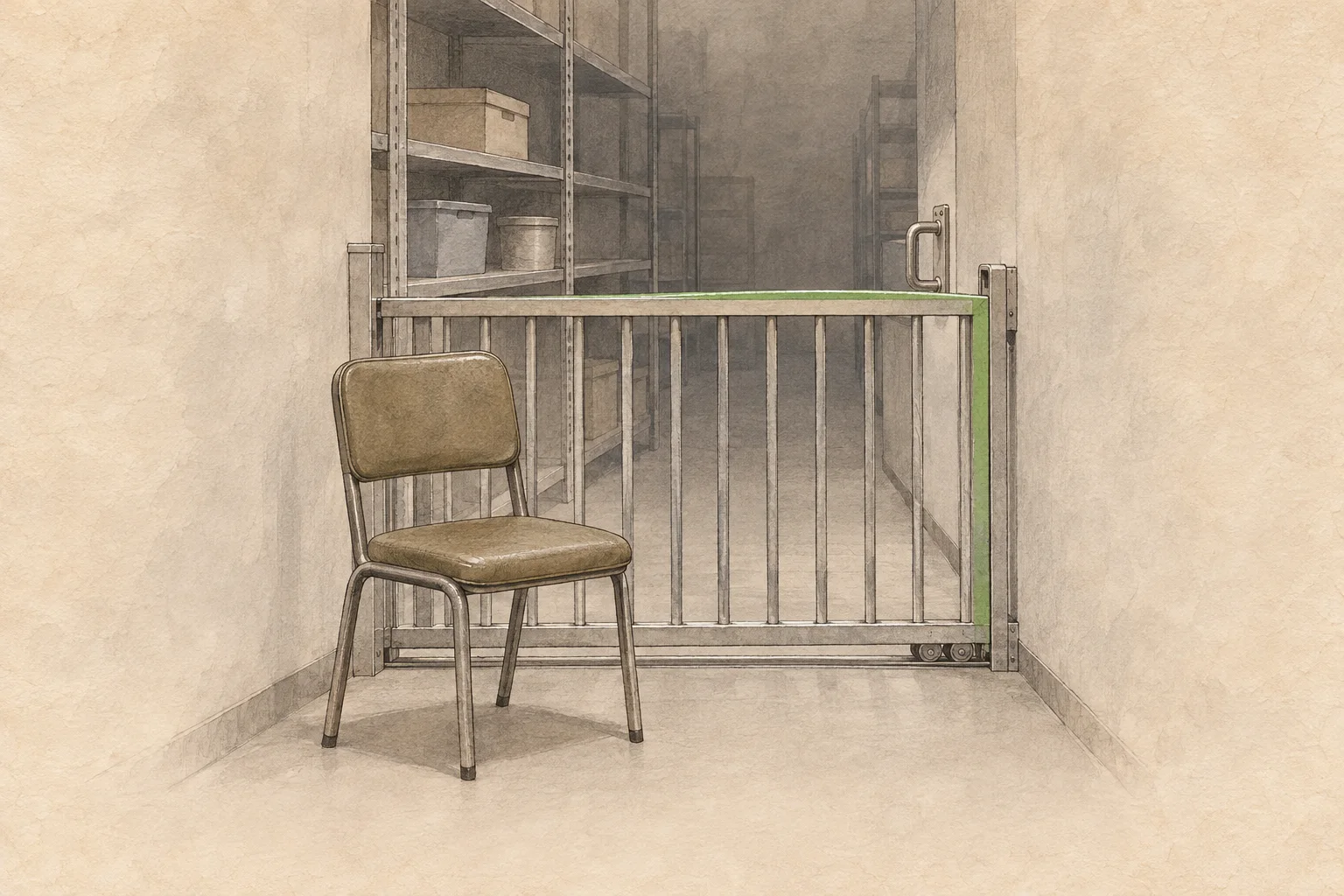
Chapter 1 left the early readers with four questions and an unnamed holder. This chapter moves from the early church and the empire to the modern political tradition, and takes up two authors who treat the holder of the restraint as a power with a definition rather than a mystery. Thomas Hobbes, in Leviathan (1651), gives an account of restraint as a power that holds back a danger named in advance, justified in this study's reading by the fear it removes; this study reads that account as a structure of restraint, and the comparison of it with other authors is this study's reading, not a claim the sources make. Carl Schmitt supplies the second; Chapter 1 named both his definition of the sovereign who decides the exception and his reading of the Pauline katechon as the power that delays the end of days. This chapter sets both readings out plainly, states the cost of each, and makes one plain statement about Schmitt that the reader is owed. It quotes no record. The ten working records enter only at the end, through the test this chapter proposes for the rest of the study.
2.1Hobbes's Holding Sovereign
Leviathan was published in 1651, in the aftermath of civil war in England. Its question is not who should rule but why anyone should obey a power they cannot unmake. Hobbes's answer begins with a covenant: an agreement by which parties bind themselves to perform and to forbear, and by which each transfers to a common power the rights each held in the condition without that power. Many people make one covenant, and the covenant produces one commonwealth. The sovereign is the person or assembly to whom that power is given, and whose acts are taken to be the acts of the commonwealth.
Chapter XIII describes the condition the covenant ends. It is a war that is not fought: "Hereby it is manifest, that during the time men live without a common Power to keep them all in awe, they are in that condition which is called Warre; and such a warre, as is of every man, against every man." In such a condition there is no place for industry, no cultivation of the earth, no arts, no letters, no society, and, worst of all, continual fear and danger of violent death: "And the life of man, solitary, poore, nasty, brutish, and short." Hobbes lists three inclinations that draw men to peace: a fear of death, a desire of things necessary to a commodious living, and a hope of obtaining them by industry. The text lists three, so treating fear of violent death as the motive for the restraint is a reading, not a report. On that reading, a restraint is held because a worse thing is feared, and many agree to be held because each fears being the one who is not held. The restraint is not a gift from the sovereign; it is the price of leaving a condition in which each person's life is at everyone's discretion.
Chapter XVII states the end of the commonwealth as the foresight of men's own preservation and of a more contented life — of getting themselves out of that miserable condition of war. Hobbes argues there that covenants without a sword are but words, and that the only way to erect a common power is to confer all strength upon one man or one assembly, reducing all wills to one by covenant of every man with every man. Of that generation Hobbes writes: "This is the Generation of that great LEVIATHAN, or rather (to speake more reverently) of that Mortall God, to which wee owe under the Immortall God, our peace and defence." A commonwealth, defined, is one person, of whose acts a multitude, by mutual covenants one with another, have made themselves every one the author, that he may use the strength and means of them all for their peace and common defence. He who carries this person is the sovereign; every one besides is his subject.
Chapter XVIII sets out the rights of sovereigns by institution. A commonwealth is instituted when a multitude agree, every one with every one, that the man or assembly given by the major part the right to present their person shall have his actions authorised by every one, him that voted against included, so that they may live peaceably and be protected against other men. Two consequences follow. First, the sovereign makes no covenant with the subjects; the covenant is of every man with every man. It follows that no breach of covenant can occur on the sovereign's part, and that no subject can free himself by any pretence of forfeiture. Second, the sovereign is judge of the means of peace and defence, of the hindrances to the same, and of what opinions and doctrines are averse to peace and what conducing to it, including who shall examine doctrines before they are published. Hobbes calls these rights inseparable and incommunicable: transfer any one of them, and the power to protect fails with the rest. The sovereign answers to no one under the covenant, because the covenant is the subjects' with one another and not with the sovereign.
The same power that holds the war back can turn against the subject, and there is no independent office that measures the one against the other. Hobbes's answer is not that the sovereign is good but that the alternative is worse. A reader who finds this structure unattractive should notice what it gains: a justification for restraint that does not depend on the holder being virtuous. In ordinary working life this is a real gain: Hobbes offers a reason to hold a control that survives the departure of its author. Chapter 4 takes up decisions that outlive their makers through Simon's account of decision-making and March and Simon's account of routines that keep a decision working (1958).
Chapter XXI states a condition on that structure. Hobbes writes: "The Obligation of Subjects to the Soveraign is understood to last as long, and no longer, than the power lasteth, by which he is able to protect them." Hobbes adds that "The end of Obedience is Protection", and that sovereignty, though immortal in the intention of those who make it, carries seeds of a natural mortality by intestine discord. What the condition gives the subject is this: obligation is not permanent — it ends where the power to protect ends. It also gives the subject one limit that survives the covenant — the natural right to protect themselves when none else can protect them cannot be relinquished. What it does not give the subject is the means to apply it: the moment, the evidence or the procedure by which to declare that the condition has been met. It is a condition on sovereignty, not a clause the subject can invoke.
Chapter XXIX shows why the distinction matters, because there Hobbes counts among the diseases of a commonwealth those that proceed from seditious doctrines. One of them is the doctrine that "every private man is Judge of Good and Evill actions". Hobbes allows that this is true in the condition of mere nature, and in cases the civil law does not determine; otherwise the measure of good and evil actions is the civil law, and the judge the legislator. A second doctrine he calls repugnant to civil society: that whatsoever a man does against his conscience is sin. It depends, Hobbes says, on the presumption of making oneself judge of good and evil: a man's conscience and his judgement are the same thing and may be erroneous, and the law is the public conscience to which the subject has already undertaken to be guided. So Hobbes states the condition and withholds the means to apply it. This study reads that absence as a feature of Hobbes's argument rather than an oversight, and reads chapter XXIX as supporting it: chapter XXI states the condition, and chapter XXIX treats the doctrine that every private man is Judge of Good and Evill as a disease that distracts and weakens the commonwealth, so that on this reading a subject who holds the right to judge whether the restraint still applies is one of the causes of the war the commonwealth was raised to end. That the absence of the means to apply the condition is the argument rather than an oversight is this study's reading, which the texts do not state.
What Hobbes gives the study, on this study's reading, is a theory of restraint as structure: a power that holds back a danger named in advance, with a justification this study draws from the fear of violent death Hobbes lists among three inclinations to peace, held by an authority whose obligation ends only when its power to protect ends, and that condition the subject cannot invoke. What it warns against is a restraint whose condition cannot be applied by the person who bears it, and a cost borne by one who cannot unmake the decision.
2.2Schmitt's Decision on the Exception
Political Theology was published in 1922, in the aftermath of war and revolution, and it begins with a definition. Schmitt defines sovereignty as the power to decide on the exception. The word "exception" is used here in a technical sense, and it must be explained before the definition can be used. An exception is, for Schmitt, the extreme case — an emergency so severe that it threatens the existence of the state and that the existing legal order cannot regulate by its own rules. For Schmitt the exception is the case no existing norm covers, which no legal norm can settle in advance. This study adds a gloss that Schmitt's own text does not state: a conflict between two ordinary rules is a matter of legal interpretation, not an exception. Extending the concept to an office or an organisation is an analogy, and not a description of what Schmitt himself argued.
On this account the sovereign is not the one who makes the rules. The sovereign is the one who decides what counts as the normal situation. That decision can be a decision about which rules apply, and it can also be a decision that the whole legal order is suspended for a time. Schmitt's argument is that the sovereign can stand outside the order in this way, because the sovereign is the one who decides whether the exception exists and when it ends. The exception is not a case within the order; it can be a suspension of the order's totality.
This produces a reversal that this study uses as a lens. The normal situation is not the starting point from which rules are derived. It is the product of the decision. The decision makes the normal situation, and the rules then run inside it. The ordinary case that people work in — the deadline, the gate, the print condition, the state a system reports — is not given in nature; it is the residue of an earlier decision about what should happen. Compliance is measured against it by people who did not set it. Chapter 4 will take up the question of decisions that are stored and still operating; this chapter states only the structural point, that the measure of the ordinary is made before the ordinary work begins.
What the sources give is this: the sovereign decides on the exception, the case no existing norm covers and which no legal norm can settle in advance, and the normal situation that decision presupposes has to be made by it. This study's reading, which that argument as the sources give it does not state, is this: the rule is defined by what it excludes; the exception shows who decided what to exclude. A reader who works in an organisation can recognise the shape without accepting the theory: in ordinary working life there are always moments when the rule does not settle what to do, and the decision made in that moment is not an application of a rule but a boundary.
The third element of Political Theology is its vocabulary. Schmitt argues that the vocabulary in which political power describes itself is borrowed from religious claims about God. The borrowing means that the shape of a claim about God is carried over to the political order, even where the religious content is not: the omnipotent lawgiver becomes the power that makes law by an act of will, and the miracle — the moment when natural law is suspended by a higher power — becomes the exception in politics. The parallel is structural. In the political tradition this study has been following, from Tertullian to Augustine, the restrainer is discussed in religious language from the start, and it is Tertullian and the readers after him who read that holding in the language of empire, a reading the text itself does not state. Schmitt makes the borrowing explicit and uses it as an argument rather than as an image.
What Schmitt's definitions give this study are two working instruments. The first is a way to describe restraints that are not rules: the ones that decide a boundary rather than fill a gap in an order. The second is the warning that whoever decides the exception decides the measure of everyone else's compliance, and that the cost of the exception is borne by the people who cannot see the decision. What the definitions warn against is equally clear. If the decision makes the normal situation, then nothing outside the decision can measure it; the normal situation cannot serve as a standard for the decision that made it, because the standard is inside the thing being measured. A restraint described this way has no revision condition built in from outside. Whether this structure can be carried over to ordinary working life is the question of section 2.4, and the answer is that only part of it can.
2.3Schmitt's Katechon and Its Burden
The Nomos of the Earth was published in 1950 and treats the order of international law known as the jus publicum Europaeum, the order in which wars were between states and the globe was divided among European powers, as an order that has collapsed. In Schmitt's account, the katechon belongs to the medieval Christian empire, the Respublica Christiana, which understood itself as the power restraining the Antichrist. In Schmitt's account the medieval empire's continuity rests on the katechon, and he sees the order of the jus publicum Europaeum dissolving at the turn of the twentieth century and after the First World War. That he turns to the figure from the Christian tradition because he is writing on the ground of an order he sees dissolving is this study's reading of his purpose, which the sources do not state.
The word is Greek and it means the one who withholds, the one who holds back. Chapter 1 set out the Pauline passage from which it comes: "only he who now letteth will let, until he be taken out of the way." The clause names a holding that ends, a holder who will hold until removed, and a removal after which that Wicked is revealed. Schmitt reads this figure as the power that restrains the antichrist and so delays the end of days. The reading that the holding delays every coming, good or bad, belongs to Cacciari and to this study, not to the letter and not to Schmitt. On Schmitt's reading the katechon is not merely useful; it withholds a specific evil until the time of revelation, and the delay is its function.
The role this gives any order that holds is the point of the section. An order that holds delays, and its justification becomes the delay it produces. The order's good is measured by what it postpones. This is a striking idea, and it must be stated with its circularity visible. If the measure of an order is the delay it achieves, then any delay is evidence of the order's goodness, and there is no standard inside the theory by which the order can be judged to have failed except by failing to delay at all. The theory supplies no criterion for asking whether the restraint is holding the right thing, because holding the right thing has been defined as holding, and holding has been defined as delaying.
The same feature appears when the restrainer is removed. The Pauline clause says that the one who holds will hold until taken out of the way. Removal releases not only the evil that was held back but also the end that the holding postponed. The letter itself names what the removal lets through: "that Wicked", an evil the Lord's coming destroys. That the end the holding postponed is released with it is Schmitt's reading of the holding as delaying the end of days, and that the removal may release good or bad is Cacciari's reading as this study extends it, as Chapter 1 marks it. The political theory makes this harder to bear, because the theory has defined the order's good as the delay, so that the removal of the restrainer looks, within the theory, like the loss of the good.
Before the rest of this chapter can use Schmitt, the statement Chapter 1 owed the reader is repeated here in brief: Carl Schmitt served the Nazi regime from 1933, and critics read his theory of the exception in that light. This study states the fact plainly because it uses the theory. The historical point is not in doubt: Schmitt joined the regime, held office within it, and wrote in its service. The scholarly point is that the account of a sovereign who decides the exception — including by suspending the whole legal order — is read by critics as a description of, and in places a justification of, a regime that suspended its own legal order. The sources used here document the biography and the criticism — Mehring's biography records Schmitt's joining the Nazi party in 1933 and Schmitt's work as a leading jurist of the regime until attacks from the SS cost Schmitt his party offices in 1936, and Gross shows that antisemitism belongs to Schmitt's thought itself — and say nothing about any dispute among historians over the details of the reading; the practice of reading the theory against the history is not in doubt here. This study therefore uses Schmitt's definitions as a lens and not as a verdict, and uses them knowing that the lens was shaped by that history. Where the lens flatters a restraint, this study shows the cost on the other side. This chapter states that rule in a provisional form and Chapter 3 adopts it, with the Conclusion repeating it, because this chapter is the place where the temptation to use the lens is strongest.
The cost of the theory is now visible. In a theory where the restraining power is justified by what it postpones, whatever the power does can be counted as delay and therefore as good. The people who bear the restraint's cost are not visible in the theory, because the theory measures the power by its function rather than by the burden it places on those held back. The removal of the restrainer is a question the theory cannot answer in favour of removal, since on the theory removal releases what the holding held back. And the theory flatters every order that holds. A lock whose reason no one remembers is, on this account, still delaying something, and its delay can be counted as its defence. Chapter 6 will meet that lock in one of the ten working records, and will carry this warning into the reading: a theory which justifies any order by what it postpones will flatter that lock, and will make the person who asks for its reason look like a person asking for the end of the world.
What the katechon reading gives this study is the shape of restraint as delay and the seriousness of the question of removal. What it warns against is grandeur, delay used as self-valuation, and the naming of a holder — whether empire, law, code or person — before the evidence supports it. The early readers of Chapter 1 gave this study a warning of the same kind: the temptation to name the holder before the evidence supports it. The modern political tradition supplies a vocabulary for the holding and a tendency to overreach. This chapter keeps both.
2.4From Sovereign to Office
What transfers from the sovereign reading of Hobbes and Schmitt into an organisation is the shape of a question: a decision made where the rules do not settle; a normal situation that was made before the work began; a decision that keeps running after its maker has gone. What does not transfer is what made the sovereign sovereign — the covenant among many to which the sovereign is not a party, its immunity from being held to account under that covenant, its standing outside the order it governs, and its lack of any condition under which it might be withdrawn.
The grounds in Hobbes are the ones section 2.1 set out. The sovereign in Leviathan holds because all have covenanted to be held, and the sovereign is not a party to that covenant; there can be no breach of covenant on the sovereign's part, and no subject can free himself by any pretence of forfeiture. The structure does contain a removal condition — the power to protect: Hobbes writes that "The Obligation of Subjects to the Soveraign is understood to last as long, and no longer, than the power lasteth, by which he is able to protect them", and that "The end of Obedience is Protection". But it is a condition the subject can recognise and not invoke: no moment, evidence or procedure is given by which to declare it met. That is what transfers structurally — a restraint whose reason is named in advance, whose justification is a worse thing avoided, and whose condition of withdrawal exists without being placed in the hands of those who bear it.
The grounds in Schmitt are the ones section 2.2 set out. The sovereign decides on the exception, and the normal situation is the product of that decision rather than the ground on which it rests. Section 2.2 used the reversal as a lens because ordinary working life has the same shape: a deadline, a gate, a print condition, a state a system reports — residues of earlier decisions, against which work is measured by people who did not set them. Section 2.3 added the cost: an order justified by the delay it produces has no standard outside itself by which it can be judged to have failed, except by failing to delay. Carl Schmitt served the Nazi regime from 1933, and critics read his theory of the exception in that light. The katechon reading of The Nomos of the Earth (1950) is a separate matter: the biography is not the reason for the structural objection, and the structural objection does not need the biography.
The strongest objection is that an office is not a sovereign, so the transfer flatters it. It has three forms. First, grandeur: calling a lock in a program a decision on the exception gives it the dignity of a sovereign act, when it is an instrument installed by someone in a role, reviewable by other roles, removable by ordinary means. Second, mystification: the sovereign reading describes a power that answers to no one, and importing it makes a manager's approval gate look like a sovereignty rather than a delegated, divided authority — able then to resist scrutiny by the very vagueness of the analogy. Third, evasion: a theory in which the normal situation is made by the decision cannot, by its own terms, judge that decision, so a workplace that borrows the language of the exception borrows a way of never having to say why a control stands. Section 2.3 showed where that leads: a lock whose reason no one remembers is still, on that account, delaying something, and the person who asks for its reason looks like a person asking for the end of the world. If the office were sovereign, the transfer would be a promotion rather than a method.
The answer is that the transfer is structural, not titular, and the objection's own premises make the answer work. What the sovereign reading supplies is not a title but questions about where the measure of ordinary work comes from: who decided that this request must wait; what could that decision have known; what normal situation did it make; what would make the measure change. Those questions lose nothing when asked of a manager's approval gate; they lose their answers when the only answer is that this is how the order is. An organisation's lock, rule, control, button or calendar is not a sovereign — it is delegated, divided, reassigned, reviewable, its holder replaceable. That is not a defect of the analogy but the point at which it is answered rather than repeated. The cost of the sovereign reading falls on people who cannot reply, because there is no commonwealth to whom they could reply; in an organisation the reply is possible in principle, which is why the objection must be answered by conceding it.
Section 13.9's claim is that a restraint can claim to hold rightly only when its reason and the condition of its removal are kept where those who wait under it can see and invoke them. Neither tradition supplies that half for ordinary work. In Hobbes the condition exists but sits with the power that holds; in Schmitt it cannot exist at all, because a measure of the normal situation made by the decision cannot be placed inside the decision. Neither supplies the statement of what would make the restraint go, written down with the decision, so that a later holder — or the person waiting behind it — can find it without asking the person who is gone. The office can supply it, because the office is not sovereign: its holders answer to other roles, its authorities are delegated, and a delegated authority can be narrowed, reassigned or withdrawn. The thesis therefore rests not on the political tradition but on the difference the objection has secured — because the office is not a sovereign, the condition of a restraint's removal can be kept with those who wait rather than with whoever decides on the exception. Whether organisations actually write such conditions down is a separate question, which the records will show.
The discipline the tradition cannot give must come from reading itself, and it is twofold. Read each restraint first as a decision somebody once made — who decided, in what role, what could they have known, what were they trying to protect, what was missing then; this reading is bounded by what was knowable at the time and must not be judged by information that arrived afterwards. Read it second as a rule that now stands alone — what it protects now, who can see that boundary, who waits, who works again afterwards, what evidence would make it go; this reading is bounded by what can be seen now and cannot be settled by the original intention. A restraint whose making was reasonable can still cost more than it protects, and a restraint whose reason is gone can still be guarding something the organisation forgot; the two readings do not settle each other, and the test asks for exactly that discipline — the discipline that keeps a reading correctable, that guards against deciding the result first and gathering only favourable words, and against abandoning a whole judgment the moment one different explanation appears. Where the tradition flatters a restraint, the cost on the other side must be shown; that is the price of carrying a question out of empire and into an office.
2.5The Reading This Study Takes Forward
In this study, restraint is the delay of a coming, good or bad — a reading extended from Cacciari's, not the letter's. The Pauline clause says that "only he who now letteth will let, until he be taken out of the way." The clause names a holding that ends and a holder who will hold until removed; the letter names what the removal lets through as an evil that the Lord's coming destroys, and leaves to later readers the question of who holds. Two reasons in the modern political tradition treat the holding as justified, and neither answers it. Hobbes lists three inclinations to peace, among them the fear of violent death; this study reads the restraint as justified by that fear, which is a reading of the text. Schmitt's katechon treats it as justified by the end it postpones. Carl Schmitt served the Nazi regime from 1933, and critics read his theory of the exception in that light. Both readings describe what a restraint does; neither says what it should do, and both would flatter a restraint that no longer has a reason.
What restrains here? The control — a lock in a program, a standing instruction, a principle at a gate, a decision not to print a label before verification, a withdrawn promise, a status that stops sales, a flow that ends before its final output, an absence, a calendar date — who can stop it and who cannot; does it hold by a decision that can still be named, or by a rule that no longer has an author? Read it as a decision somebody once made, and ask what could have been known at the time.
What does it protect? Which boundary, promise, transaction, time — and who can see that boundary? What the person acting within a restraint often cannot see is of a similar kind: the scope of what the restraint holds back, or the condition on which its own action depends. This is a property of how the scenes were recorded, each naming an element that is missing — not a finding about organisations in general. A person who receives only a conclusion may not even know what to ask, and Schmitt's reading says why that matters: the normal situation was made before the work began, and the person working inside it measures compliance against a boundary they did not set.
What does it cost and who pays? Who waits, who works again afterwards, who bears the explanation and the apology — and does any record link that follow-on cost to the decision that approved it? The sovereign reading answers by pointing to the worse thing avoided. The organisational reading must answer by naming the people, and the difference between the two answers is one reason this study refuses to conclude that restraint is good or bad in general.
What would make it go? What evidence, what revision condition, written down with the decision, so that a later holder can find it without asking the person who is no longer there? Neither reading supplies this half of the test: a sovereign power with a revision condition is not the power Hobbes describes, and a theory that measures an order by the delay it produces cannot say when the delay has become the cost.
Any order which delays harm is not thereby good. Delay is not a virtue by itself; a delay can also delay the remedy, and the cost falls on people who did not choose it. Hobbes lists fear of violent death among three inclinations to peace, and this study reads the restraint as justified by the fear it holds back; the katechon reading justifies it by the end it postpones; both would flatter a control whose reason is gone. Where the tradition flatters a restraint, the cost on the other side will be shown — in Part II, as who waits and who works again; in Part III, as the question of when the restrainer should be taken out of the way.
No record is quoted here: the readings through Hobbes and Schmitt are this study's interpretation, written to be corrected like every reading in the study. Chapter 3 continues the tradition with the delay itself and those who read it as a reshaping of time; Chapter 4 turns from empire to office through Max Weber, Herbert A. Simon, Charles Perrow, Karl E. Weick and G. K. Chesterton. The instruction the study will repeat at every use of the tradition: read the restraint twice — once as a decision somebody once made, once as a rule that now stands alone — and refuse to let either reading settle the other.
2.6Schmitt's Katechon and Its Critics
Seven works bear on the use of Schmitt made in sections 2.2 and 2.3: three on how he uses the katechon and what kind of thinker he was, two disputing the ground on which any movement from theology into politics stands, two on Schmitt as a person and a jurist. None settles the four questions Chapter 1 left standing; each changes the standing of one.
2.6.1 How Schmitt uses the figure
Grossheutschi traces how and why Schmitt uses the katechon across his works, with its background in the letter, in the church fathers, and in the readings that found Rome in the passage. This bears on section 2.3, which presented the katechon as Schmitt's move in The Nomos of the Earth: the move is sustained rather than passing, since Schmitt returns to the figure again and again. The gain is a firmer object of study, for what is being read is a habit of thought and not one convenient sentence, and the circularity identified in section 2.3 is therefore a property of the habit. The risk is that a habit resists the two-part test of section 2.4, because it has no single moment of decision to identify and date.
Hell reads Schmitt's katechon as an imperial theology, bound up with the Third Reich's imitation of Rome, and gives the concept an imperial genealogy. This bears on what does it protect: on Hell's reading the katechon protects an order by making that order the holder of the delay. This study reads from Hell's genealogy that the circle tends to acquire a candidate for the holder, and that the candidate is an empire modelling itself on a predecessor. The transfer to an office is instructive rather than literal: no workplace models itself on Rome, but a control can be defended by the same structure, the claim that it stands between the present and a worse state. Section 2.5's refusal needs Hell's reading to keep its edge. Delay is not a virtue by itself.
Meier reads Schmitt as at bottom a political theologian, whose faith in revelation shapes his concept of the political, and sets this against political philosophy. This supports section 2.2's treatment of Schmitt's borrowed vocabulary as an argument rather than an image: the vocabulary is not decoration on the theory; it supplies the theory's shape. Moving a concept out of a religious text into an office is ordinary traffic in political thought, and the traffic does not guarantee the result. Section 2.4's answer stands on its own — an organisation's lock is an instrument, not a sovereign — and Meier's reading is one reason to keep that sentence attached to every later use of Schmitt.
2.6.2 The dispute about origins
Peterson's essay argues that the Christian doctrine of the Trinity, and the eschatology of the church, end any Christian political theology that mirrors one God in one monarch. Schmitt answered it in Political Theology II (1970), thirty-five years later. The dispute touches section 2.2 directly, since Schmitt's borrowed vocabulary takes the shape of a single sovereign power, which is the mirroring Peterson says the doctrine rules out. The gain is a reminder that the theological parallel was contested by theologians before it reached organisational life. The risk is that the dispute settles nothing about a lock, because a lock answers to no doctrine, and a reader who takes comfort in the argument being unresolved may forget to ask who is waiting behind the lock.
Blumenberg argues against the thesis that modern concepts are secularised theological ones. On his account the modern age has a legitimacy of its own, as human self-assertion, and he disputed Schmitt's political theology on this ground. This is the sharpest challenge to the method of this chapter, because sections 2.1 through 2.3 all move a concept from a religious setting into a modern political one. If Blumenberg is right, the resemblance between the two may be a coincidence of form rather than descent. This study does not have to settle that dispute; it has to say plainly what section 2.5 said of its own readings: restraint as delay is an interpretation carried forward from Cacciari and extended by this study, written to be corrected, and not a finding about the origin of any concept in use.
2.6.3 The man and the theory
Gross shows that antisemitism belongs to Schmitt's thought itself, not only to Schmitt's conduct after 1933. Mehring's biography documents Schmitt's joining the Nazi party in 1933 and Schmitt's work as a leading jurist of the regime until attacks from the SS cost Schmitt his party offices in 1936. The statement this chapter owes the reader stands again here, because this section uses Schmitt's thought as much as section 2.3 did: Carl Schmitt served the Nazi regime from 1933, and critics read his theory of the exception in that light.
The date of the book falls after the party offices were lost, but the assessment of the reading rests on the reading itself, on Hell's genealogy and on Grossheutschi's tracing, not on the biography. Collapsing the two would let the biography do the work of an argument, and the critics' structural objection is stronger than any biographical one: the theory has no place inside it for the people who bear the restraint.
2.6.4 What the critics leave
The critics leave this study with a limit rather than a conclusion. A katechon read as the justification of any order that holds is exactly the use this study must not make of it in an office. Sections 2.3 and 2.5 arrived at that limit from inside the theory; the seven works arrive at it from outside, and the outside is worth having because the inside of the theory cannot generate it.
The limit bears on the four questions unevenly. On what restrains here, the scholarship adds little: the holders in the ten records are roles and instruments, and no critic of Schmitt names them. On what it protects, Hell and Grossheutschi sharpen the question by showing that a restraining order tends to nominate itself as the protection. On what it costs and who pays, Gross and Mehring supply the strongest reason this chapter will not accept delay as a defence, because the cost falls on people the theory does not count. On when the restrainer should be taken out of the way, the critics leave the question where section 2.3 left it: a theory that measures an order by the delay it produces cannot answer in favour of removal, so that answer must come from elsewhere, and this study looks for it in the revision conditions the records write for themselves rather than in Schmitt.