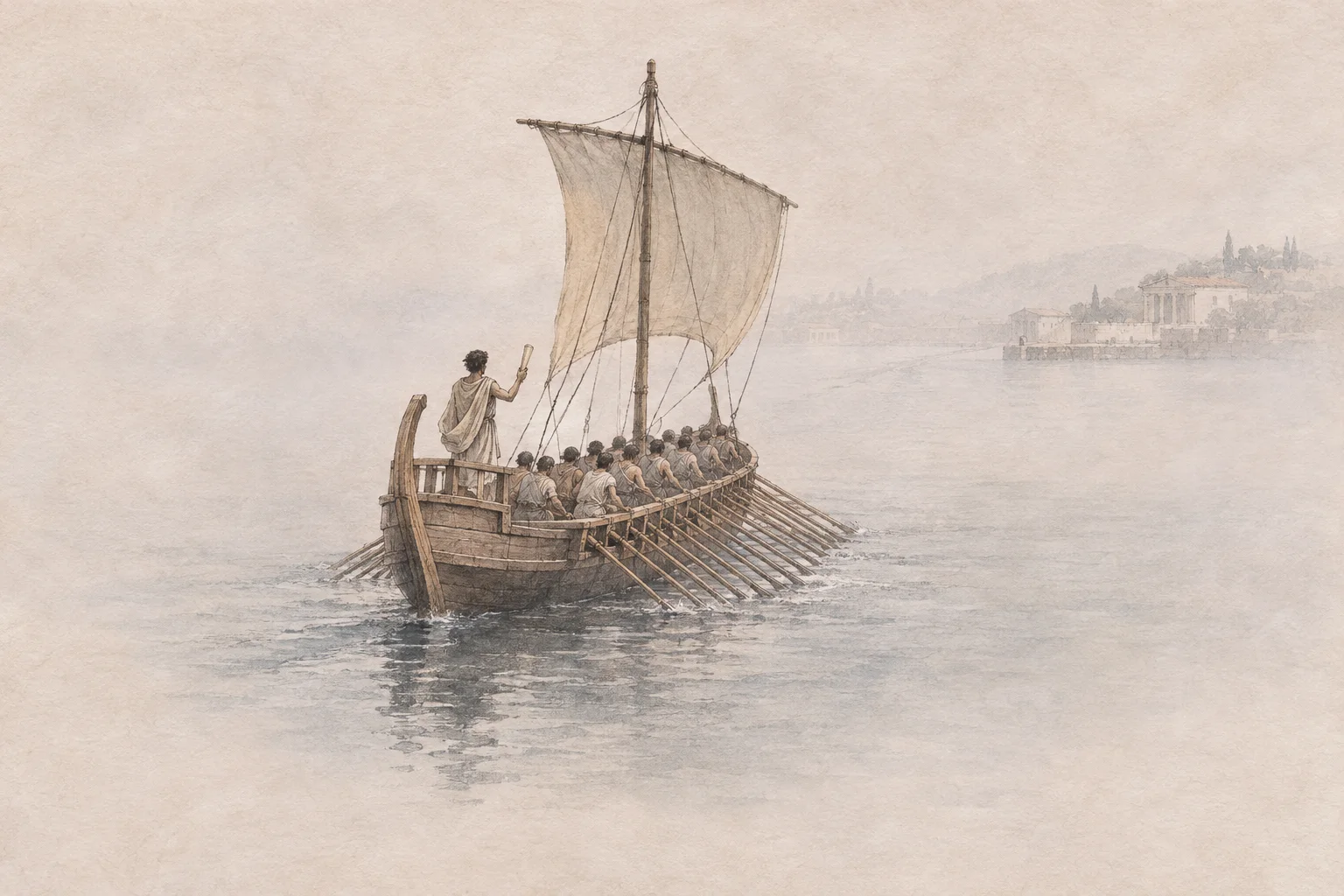
A decision that can be reversed is not yet a decision that will be reversed in time. None of the works on correctable decisions cited here asks directly what makes an order to stop something that people outside the room can see, carry and act on, rather than a sentence in a file. This article reads the Mytilenean episode in Book III of Thucydides' History of the Peloponnesian War, in Richard Crawley's translation, as a text about that question. The Athenian assembly voted to kill the men of Mytilene, reconsidered the next day and reversed itself by a near-even vote; a second galley left a day and a night behind the first and arrived just as the commander was preparing to carry out the first decree. What made the reversal effective, the article argues, was not the wording of the second decree but five features of its setting: a known head start, a carrier with reasons to hurry, a reader at the far end, an act not yet done, and luck. The reading is set beside the debate between David Collingridge's case for corrigible decisions and Lee Clarke's account of plans that could not work as written but serve to persuade. Two decision records published by Meridian, a platform of the RISCON family, serve as a modern test: a ceasefire verification board deciding who keeps observation records, and a committee deciding how to correct conflicting records of missing persons. Both are modern summaries written by AI about fictional polities, not archival documents. They name roles, cycles and stop points with care, yet leave most triggers to the judgment of the role that checks them. The article draws no conclusion about which option either record should take.
Layout
Abstract
By RISCON Labs AI from 2 Meridian records and the public-domain texts it reads · the records are synthetic settings summarised by AI, and their judgments are AI-generated · the readings through the works named are this study's interpretation · First edition · October 2026