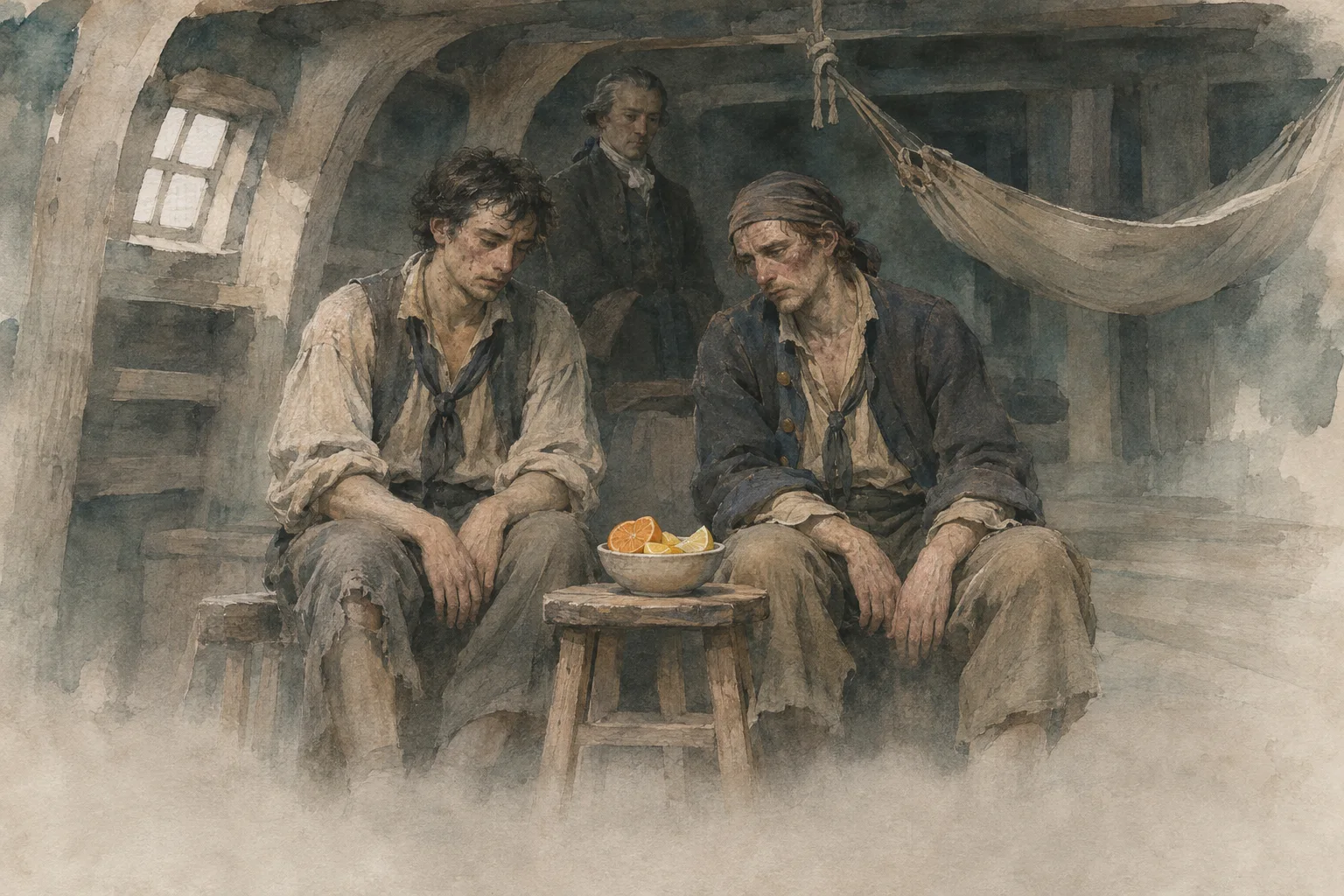
The historical claim of this section is that Jenner's Inquiry makes, in its opening pages and its close, a claim far wider than its experiments, that the widest of these claims is stated without a hedge, and that the same text nonetheless names its incomplete experiments and the conjecture it admits. For the debate, the section adds a second test of Marks's and Porter's accounts. Jenner, whose first report was refused, does not turn to rule or count to make up for his standing; he turns to cases, his own vouching, and a definition that separates true cowpox from false.
5.1The opening argument
Jenner's Inquiry opens with a dedication to C. H. Parry, dated from Berkeley on 21 June 1798. In it Jenner describes his method in a single sentence: "Finding the prevailing notions on the subject, both among men of our profession and others, extremely vague and indeterminate, and conceiving that facts might appear at once both curious and useful, I have instituted as strict an inquiry into the causes and effects of this singular malady as local circumstances would admit." The strictness claimed is bounded at once by its setting. The inquiry is as strict as local circumstances allowed, which is a statement about a country practice, not about a protocol.
The body of the Inquiry then begins far from the cow. It begins with a theory of the origin of disease in domestication, and moves to the horse. "There is a disease to which the Horse, from his state of domestication, is frequently subject. The Farriers have termed it" the grease, Jenner writes, and he describes "an inflammation and swelling in the heel, from which issues matter possessing properties of a very peculiar kind, which seems capable of generating a disease in the Human Body (after it has undergone the modification which I shall presently speak of), which bears so strong a resemblance to the Small Pox, that I think it highly probable it may be the source of that disease."
Here, in the third paragraph of the work, is a causal claim of the largest kind: that the grease of horses is probably the source of smallpox itself. Jenner marks it with "I think it highly probable". Nothing in the cases that follow tests it. It is a hypothesis about the origin of a disease, placed at the head of a report on prevention.
The mechanism of transmission follows in the same confident register. A man dresses a horse's heels, does not wash, milks the cows, and "When this is the case, it commonly happens that a disease is communicated to the Cows, and from the Cows to the Dairy-maids, which spreads through the farm until most of the cattle and domestics feel its unpleasant consequences." Jenner then describes the disease in the milkers with care, and closes the description with an honest uncertainty about one detail: of eruptions on the skin, he writes that a few appeared in one case only and "soon died away without advancing to maturation; so that I cannot determine whether they had any connection with the preceding symptoms."
Then comes the central claim of the book, in a single sentence that carries no hedge at all: "Morbid matter of various kinds, when absorbed into the system, may produce effects in some degree similar; but what renders the Cow-pox virus so extremely singular, is, that the person who has been thus affected is for ever after secure from the infection of the Small Pox; neither exposure to the variolous effluvia, nor the insertion of the matter into the skin, producing this distemper."
The phrase "for ever after" is the widest in either report. It claims protection for a lifetime, against both natural exposure and deliberate inoculation, before a single case has been laid out. Jenner's next sentence promises the evidence: "In support of so extraordinary a fact, I shall lay before my Reader a great number of instances". The reading note on the Inquiry describes the work as reporting few cases and arguing from them that cowpox protects against smallpox (Jenner 1798). Jenner calls the protection a "fact" and the number of instances "great". Both words are his.
5.2The definition that guards the claim
A footnote to that promise does important work. Jenner warns that "pustulous sores frequently appear spontaneously on the nipples of Cows", that these are milder than the true disease, lack its livid tint, and quickly scab over. "But this disease is not to be considered as similar in any respect to that of which I am treating, as it is incapable of producing any specific effects on the human Constitution. However, it is of the greatest consequence to point it out here, lest the want of discrimination should occasion an idea of security from the infection of the Small Pox, which might prove delusive."
The footnote is a caution, and a sensible one: a milker who had had the mild sores should not think herself safe. It also defines the scope of the central claim. Protection "for ever after" belongs to those affected by true cowpox, and true cowpox is recognised by its appearance. A person who had cowpox-like sores and later caught smallpox can be placed outside the claim by being placed outside the definition. The text does not say that Jenner used the distinction in that way, and this article does not suggest that he did. It records that the claim, as written, is protected by a definition, and that the definition is drawn from appearances.
The study's ledger, reading the record rather than the text, found the record's figures qualified by a definition or scope. The text supports that reading more strongly than the record does, because the definition of true cowpox is the hinge on which the whole claim turns.
5.3Case XVII as Jenner wrote it
The case that both reading notes single out is told in four paragraphs. The first states purpose, subject, source and procedure: "The more accurately to observe the progress of the infection, I selected a healthy boy, about eight years old, for the purpose of inoculation for the Cow Pox. The matter was taken from a sore on the hand of a dairymaid" … "who was infected by her master's cows, and it was inserted, on the 14th of May, 1796, into the arm of the boy by means of two superficial incisions, barely penetrating the cutis, each about half an inch long."
The second gives the course: "On the seventh day he complained of uneasiness in the axilla, and on the ninth he became a little chilly, lost his appetite, and had a slight head-ach. During the whole of this day he was perceptibly indisposed, and spent the night with some degree of restlessness, but on the day following he was perfectly well."
The third compares the local appearances with those of inoculated smallpox and finds them "much the same", with a darker fluid and an inflammation of more erysipelatous look, and ends: "but the whole died away (leaving on the inoculated parts scabs and subsequent eschars) without giving me or my patient the least trouble."
The fourth is the test: "In order to ascertain whether the boy, after feeling so slight an affection of the system from the Cow-pox virus, was secure from the contagion of the Small-pox, he was inoculated the 1st of July following with variolous matter, immediately taken from a pustule. Several slight punctures and incisions were made on both his arms, and the matter was carefully inserted, but no disease followed. The same appearances were observable on the arms as we commonly see when a patient has had variolous matter applied, after having either the Cow-pox or the Small-pox. Several months afterwards, he was again inoculated with variolous matter, but no sensible effect was produced on the constitution."
Read for what it could show, Case XVII is a single subject, inoculated once with cowpox and twice afterwards with smallpox matter, with no visible disease following either challenge. It could show that this boy, on these two occasions, did not develop smallpox from inoculation after cowpox. It could not show that the protection lasted for life, since the second challenge came "Several months afterwards" and the book went to press in 1798. It could not show that the cowpox caused the protection, since the case as printed says nothing of whether the boy had met smallpox before, and no comparison with a boy who had not had cowpox. And it could not show anything about natural exposure to smallpox, since the challenges were by inoculation.
Jenner's own wording in the test paragraph is careful. He says he inoculated the boy "In order to ascertain whether" he was secure. He reports the outcome as "no disease followed" and "no sensible effect was produced", which are observations, not inferences. The inference is left to the reader, or rather to the opening argument, which had already declared the fact.
5.4The interruption and the incomplete experiment
The text then does something that a reader of the famous case may not expect. It stops. "Here my researches were interrupted till the spring of the year 1798, when from the wetness of the early part of the season, many of the farmers' horses in this neighbourhood were affected with sore heels, in consequence of which the Cow-pox broke out among several of our dairies, which afforded me an opportunity of making further observations upon this curious disease."
Jenner had a single inoculation of 1796 and nothing more of the kind until the outbreak of 1798 gave him matter again. The case that stands behind the opening's "extraordinary" fact was followed, by his own account, by an interruption that lasted until the spring of 1798. The reason he gives is the absence of cowpox in the dairies, not any doubt.
Case XVIII, which follows, is an experiment Jenner could not finish: "JOHN BAKER, a child of five years old, was inoculated March 16, 1798, with matter taken from a pustule on the hand of Thomas Virgoe, one of the servants who had been infected from the mare's heels. He became ill on the 6th day with symptoms similar to those excited by Cow-pox matter. On the 8th day he was free from indisposition." The purpose was to see whether matter passed from the horse through a person would protect as matter from the cow did. Jenner states plainly that it does not yet know: "We have seen that the virus from the horse, when it proves infectious to the human subject is not to be relied upon as rendering the system secure from variolous infection, but that the matter produced by it upon the nipple of the cow is perfectly so. Whether its passing from the horse through the human constitution, as in the present instance, will produce a similar effect, remains to be decided. This would now have been effected, but the boy was rendered unfit for inoculation from having felt the effects of a contagious fever in a work-house, soon after this experiment was made."
Two features of that paragraph matter for the question of claims. The first is the open admission: "remains to be decided". Jenner names an experiment he did not complete and does not count it as support. The second is the sentence before it, which states with no hedge that matter from the cow's nipple is "perfectly" protective. The claim and the confession of its limits stand next to each other, in successive sentences.
5.5The closing argument
The Inquiry ends by answering the question whether all this is "a matter of mere curiosity". Jenner's answer is a comparison of risks, and it begins with the dangers of the established practice: "I should answer, that notwithstanding the happy effects of Inoculation, with all the improvements which the practice has received since its first introduction into this country, it not very unfrequently produces deformity of the skin, and sometimes, under the best management, proves fatal."
Against those dangers he sets the new procedure: "But as I have never known fatal effects arise from the Cow-pox, even when impressed in the most unfavourable manner, producing extensive inflammations and suppurations on the hands; and as it clearly appears that this disease leaves the constitution in a state of perfect security from the infection of the Small-pox, may we not infer that a mode of Inoculation may be introduced preferable to that at present adopted, especially among those families, which, from previous circumstances we may judge to be predisposed to have the disease unfavourably?"
The sentence is built with care. Its first ground is stated as personal experience, "I have never known", which is a true report of what one physician has seen and no more. Its second ground, "it clearly appears", restates the central claim with the word "perfect". Its conclusion is put as a question, "may we not infer", and restricted, at first, to families thought likely to suffer badly from smallpox. The proposal is narrower than the premise.
Jenner then adds a claim about transmission, from what he has seen. Cowpox, he says, does not seem able to spread "from effluvia, or by any other means than contact", so that "a single individual in a family might at any time receive it without the risk of infecting the rest, or of spreading a distemper that fills a country with terror." He offers his evidence: "Several instances have come under my observation which justify the assertion that the disease cannot be propagated by effluvia. The first boy whom I inoculated with the matter of Cow-pox, slept in a bed, while the experiment was going forward, with two children who never had gone through either that disease or the Small-pox, without infecting either of them." Two more instances follow, a dairymaid who shared a bed with another, and a young woman with cowpox sores who nursed an infant daily. These few cases of non-transmission carry the word "cannot".
The book's further reach is put as questions. Of people who resist inoculation and live in fear of later infection, Jenner writes that "A ready mode of dissipating anxiety originating from such a cause must now appear obvious." And he asks whether cowpox might "in many chronic diseases be introduced into the system, with the probability of affording relief, upon well-known physiological principles?" That is the furthest speculative reach in either report, and it ends in a question mark.
5.6A case that does not fit, and how it is read
One case in the closing pages tests the central claim from the other side. Jenner writes: "Elizabeth Sarsenet lived as a dairy maid at Newpark farm, in this parish. All the cows and the servants employed in milking had the Cow-pox; but this woman, though she had several sores upon her fingers, felt no tumors in the axillae, nor any general indisposition. On being afterwards casually exposed to variolous infection, she had the Small-pox in a mild way."
Here is a person who had cowpox sores and later caught smallpox. Read against "for ever after secure", it is a counter-instance. Jenner reads it otherwise. He introduces it as "a single instance before me where the virus acted locally only", sets beside it a fellow dairymaid, Hannah Pick, who had the general illness and resisted his attempts to give her smallpox, and concludes: "From the former Case then we see that the animal economy is subject to the same laws in one disease as the other." The case becomes evidence that protection requires the system to be affected, not merely the skin.
That reading is the same move as the qualification in Case XVII, where the challenge was made to see whether the boy was secure "after feeling so slight an affection of the system". The claim that emerges is more precise than the opening sentence: protection follows true cowpox that affects the constitution. It is also harder to refute, since any failure can be assigned to a local infection or a spurious disease. The text does not show whether Jenner held this condition before he met the Sarsenet case or drew it from that case. It shows only that the condition is stated after the case and in order to account for it.
5.7Jenner on his own method
The final paragraph of the Inquiry describes what kind of work it is: "Thus far have I proceeded in an inquiry, founded, as it must appear, on the basis of experiment; in which, however, conjecture has been occasionally admitted in order to present to persons well situated for such discussions, objects for a more minute investigation. In the mean time I shall myself continue to prosecute this inquiry, encouraged by the hope of its becoming essentially beneficial to mankind."
This is the plainest answer either report gives to the question of how much it claims. Jenner names two components, experiment and conjecture, and says the second was admitted on purpose, to give others "objects for a more minute investigation". In George and Bennett's terms, that is the language of a plausibility probe, a preliminary study meant to show that an idea deserves fuller testing (George and Bennett 2005). It sits uneasily beside the opening's "so extraordinary a fact" and "for ever after", which are not the language of a probe. The Inquiry speaks in both registers, and the reader is left to weigh them.
A further case in the closing pages shows the same pairing. On the colt at Rockhampton, whose inflamed thigh Jenner thought had given cowpox to twenty-four cows and their milkers, Jenner writes that the identity of the disease leaves "scarcely any room for suspicion; yet it would have been more completely satisfactory, had the effects of variolous matter been ascertained on the farmer's wife, but there was a peculiarity in her situation which prevented my making the experiment." Again a confident claim and a named missing test stand together.
5.8The record beside the text
Skeptron's record states the core of Case XVII in two sentences:
The 1798 Report states that the material obtained from the hand lesion of Sarah Nelmes, who was infected with cowpox, was vaccinated to eight-year-old Phipps. The subsequent exposure and observation of the course were separate stages.
The second sentence is exact and useful: the inoculation of 14 May and the challenge of 1 July were separate steps, and the record keeps them so. The first sentence differs from the 1798 text in two details. Jenner calls the boy "about eight years old"; the record makes him "eight-year-old". And Jenner does not name the boy at all. The record supplies the name Phipps, which the reading notes give as known from later sources (Jenner 1798; Riedel 2005). The dairymaid's name, Sarah Nelmes, is in Jenner's footnote, so on her the record and the text agree. The record says "The 1798 Report states" of a sentence that the 1798 report does not state in that form. A modern summary has filled in a name from later knowledge and rounded an approximate age into an exact one, under a verb that attributes both to the original.
The record's boundary sentences are closer to the spirit of the text:
The limits of the number of subjects and procedures must be preserved. The unethical human exposure of that time is not proposed as a replication experiment; only the inputs, dates, and range of results in the record are compared.
And, under what remains unknown:
Vaccination and the 1798 publication are separated. Judgments on current medical efficacy and safety require separate evidence.
These separate the act of 1796 from the report of 1798, as Riedel's chronology also does: a first report refused by the Royal Society in 1797, and a private printing in 1798 (Riedel 2005). The record says nothing of the refusal. It also says nothing of the Inquiry's widest claims: the horse as the probable source of smallpox, protection "for ever after", the impossibility of spread by effluvia, the use against chronic disease. A reader of the record alone would meet a careful single-case report with its limits preserved. A reader of the Inquiry meets that report embedded in a far larger argument, and also meets the author's own admission of conjecture, which the record does not carry either.
5.9What this case adds
For the debate, Jenner's Inquiry gives a sharper result than Lind's chapter. On Marks's account, the report rests on personal judgment, and its claims run well ahead of its design: "for ever after" from challenges months apart, "cannot be propagated" from a few instances, a probable origin of smallpox from no test at all. The gap that a later discipline was built to police is wide here, and the opening argument does not police it. But the closing pages do some of that work in the author's own voice: they name an unfinished experiment, a missing test on the farmer's wife, and the conjecture admitted to set others investigating. On Porter's account, Jenner is the contested expert, refused by the Royal Society; he does not reach for rule or number. His defence of the claim is a definition of true cowpox and a reading of the Sarsenet case that narrows the claim to those whose constitution was affected. On Rusnock's account, the eighteenth-century comparison of deaths from natural and inoculated smallpox was the natural way to settle the worth of inoculation; Jenner's risk argument invokes that comparison in words, "sometimes, under the best management, proves fatal", without giving a single count.