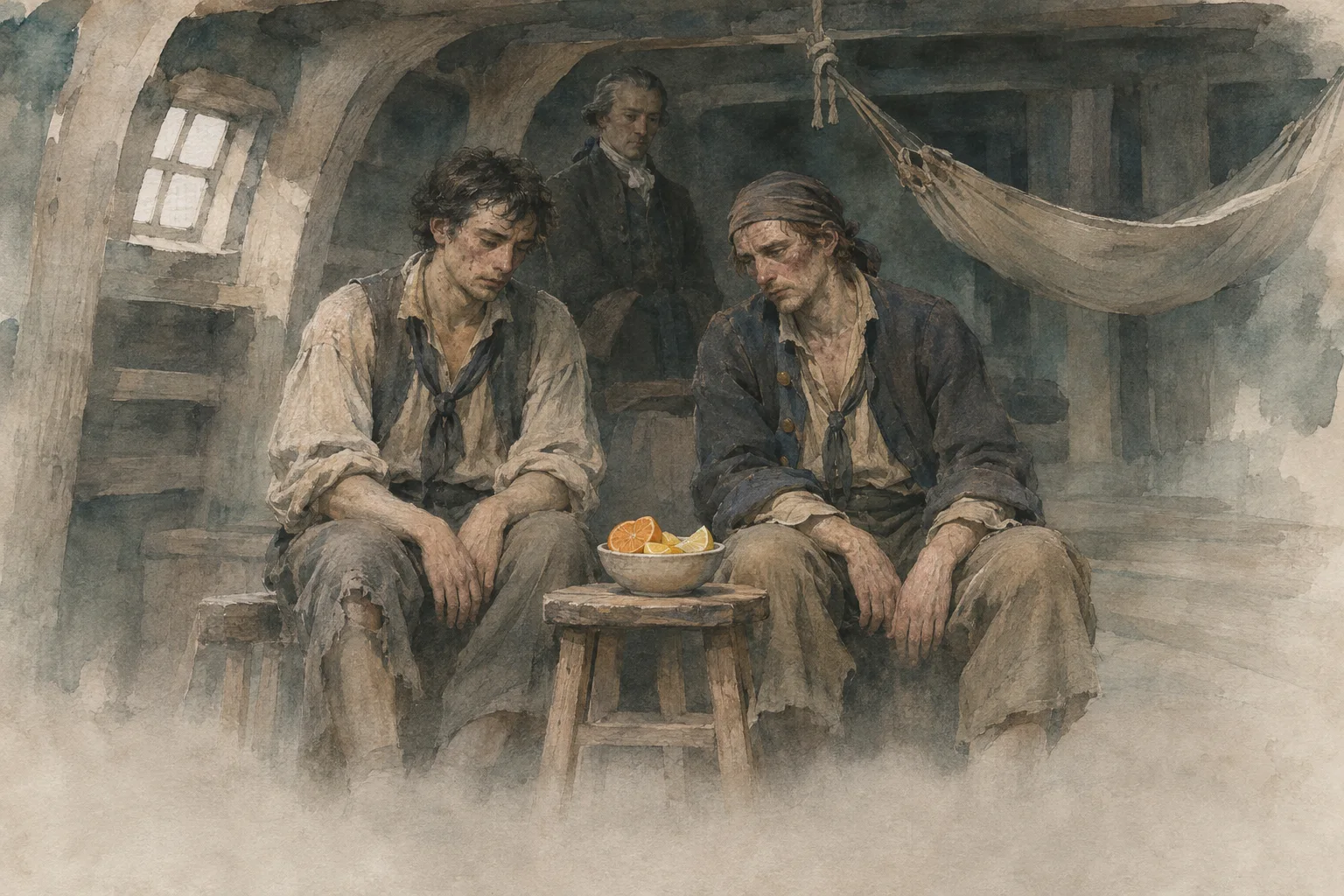
6.1Two reports, one source of authority
The two reports share a voice. Both are written in the first person, both describe what the author did and saw, and neither gives a reader any means of checking the outcome except the author's word. Lind took the twelve, Lind gave the treatments, Lind judged that one man was fit for duty and another was the best recovered. Jenner selected the boy, made the incisions, saw that no disease followed. The supporting evidence each adds is of the same kind: Lind's footnote is a letter from another surgeon describing his own experience; Jenner's later cases are farms and milkers in his own neighbourhood and parish. In that respect the reports fit Marks's account closely (Marks 1997). They are the work of individual practitioners who vouch for themselves, and nothing in them anticipates the collective discipline of controlled experiment, with its rules for allocation and its independence from the judgment of the physician who treats.
They fit Rusnock's account less well. Neither report argues from a count of deaths. Lind's outcome is told in words. Jenner's risk argument names the fatality of smallpox inoculation without a number. The only figures in either text that compare outcomes across groups are Ives's burials per ship, in a footnote, without the counts of sick that would give them meaning. If eighteenth-century physicians were already settling the worth of inoculation by comparing deaths, as Rusnock shows (Rusnock 2002), Jenner's Inquiry did not take that route. It argued from cases and a mechanism.
Porter's account does not find in Jenner the turn to rules that weakness predicts (Porter 1995). The refused author, printing privately, does not make up for his standing by a procedure that anyone could follow. He offers more cases, a sharper definition and a frank statement that conjecture has been admitted. Whether that fails to support Porter's account or simply shows that the eighteenth century had not yet made rules available as a substitute for trust is a question the two texts cannot decide. Porter's argument is about institutions; two private reports do not test it fully.
6.2Where the claims outran the trials
The article's question was how far each report claimed more than its trial could show. The answer differs between the two, and in a way that does not follow the reputations of the trials.
Lind's trial looks closer to the later controlled comparison, since it set several treatments side by side under shared conditions; the platform's record of it even asks whether it may be treated as equivalent to modern randomized trials. His chapter's claims, read in full, are the narrower of the two. His general conclusion is bounded to the sea and phrased as a comparison. His one claim that the design could not have supported, the preference of oranges over lemons, is hedged. His irregular arms are disclosed. Where his chapter does reach beyond the twelve, it does so by appeal to other experiments not reported there and to a single marine and a letter from Ives, all of them weaker evidence than the trial itself.
Jenner's trial is a single subject with a challenge. His claims, read in full, are the wider. Lifelong protection, impossibility of airborne spread, the horse as the origin of smallpox and the possible use of cowpox against chronic disease all go beyond what Case XVII and its companions could show. Yet Jenner's report is also the one that names its own method most frankly, in the closing sentence on experiment and conjecture, and the one that leaves an experiment explicitly undecided.
Carpenter's history and the reading note on the Treatise point to the same asymmetry from outside the reports. Lind did not conclude that citrus was a specific remedy; he held to a theory of scurvy as a disorder of digestion and perspiration (Carpenter 1986), and the Treatise as a whole does not present citrus as a sole or specific cure (Lind 1753). The navy's routine issue of lemon juice came decades later. Jenner's claim, refused by the Royal Society, nonetheless led to a practice that, in Riedel's summary, spread quickly (Riedel 2005). The report that claimed less was followed by a long wait; the report that claimed more was followed by rapid adoption. The two texts do not show why. They show only that the size of a claim in a report and the speed of the action that followed did not move together in the inverse direction that a reader might expect from the strength of each design.
6.3Acting before proof
The two trials sit on either side of the precaution debate. The interval between Lind's report and the navy's issue of lemon juice has the shape of the cases in Late Lessons from Early Warnings: an early signal, available in print, and action long delayed (Harremoës and others 2001). But Lind's own report is not an early warning of the kind those editors describe, since it did not claim that citrus was the specific remedy, and Lind's own recommendation, by Carpenter's account, was a boiled concentrate that lost much of its virtue (Carpenter 1986). The delay cannot be read from the chapter as a failure to heed a clear signal. What the chapter shows is a signal mixed with a theory that weakened it.
Jenner's argument for cowpox inoculation is, by contrast, a case for acting before proof on the ground that the existing practice also carries risk. Variolation "sometimes, under the best management, proves fatal"; cowpox, in his experience, never had. This is Sunstein's point in Jenner's own terms: risks lie on all sides, and declining the new procedure is not a choice without danger (Sunstein 2005). Jenner's proposal also has the features Neustadt and Fineberg warn against: a large claim on thin evidence, and the merging of separate questions (whether cowpox protects, for how long, whether it spreads, where it came from) into one argument (Neustadt and Fineberg 1978). But it has, too, what they recommend: a stated intention to continue the inquiry and an open invitation to others to test it, which is something like a planned point of reconsideration. The texts permit both readings. Neither tells a reader which should govern.
6.4What the modern summaries keep and what they add
The two platform records were written with the separation of times as a principle. Both keep the trial apart from its report and the report apart from what followed. Both decline to supply what the eighteenth-century texts did not say about allocation, blinding or modern efficacy. In those respects they are better guides to the question of this article than many short accounts of the two trials would be.
They also add and subtract in ways that matter for the question of claims. The Lind record reduces a comparison with several disclosed irregularities to "compared in pairs" with a "rapid improvement of the group given citrus fruit", and so loses the evidence by which Lind himself limited his result. The Jenner record names a boy the 1798 text left unnamed and gives an exact age for an approximate one, under the words "The 1798 Report states". The first is a loss of the author's own caution; the second is an addition of later knowledge to the author's text. Neither changes the central facts of the cases. Both show that a modern summary, even one written to keep times apart, can move a detail from a later time into an earlier document.
This is the point at which the platform records and the debate meet. Marks's account is a history of how the authority of trials came to rest on procedures rather than persons. A short modern record of an early trial is itself a small act of authority: it tells a reader what the trial was. The two records do that carefully, but they keep less of the reporters' own hedges than the reporters did, and in one case they attribute to the reporter what came from others.
6.5What the evidence cannot carry
The evidence of this article is two texts and two records. It cannot say how Lind's trial was actually conducted beyond what his chapter reports, how Jenner chose his cases or whether he omitted others, how either report was read in its own decade, or why the navy and the public acted as they did. It cannot say whether either author claimed too much by the standards of his time, since the standards of the time are not in the evidence. Lind's chapter is read here only in its passage on the trial and its footnote, and the Treatise's broader theory is known to this article only through the reading notes. Jenner's Inquiry is read in its opening, its seventeenth and eighteenth cases and its close; the earlier cases are known only through the note that describes them as few.
Flyvbjerg's defence of the single case (Flyvbjerg 2006) cuts both ways here. It supports reading Case XVII as more than an anecdote, since a well-chosen case can test a general claim. It also supports reading these two reports, which are only two, as cases from which something general may be learned about early trial reports. The article has tried to draw from them only what their sentences show.