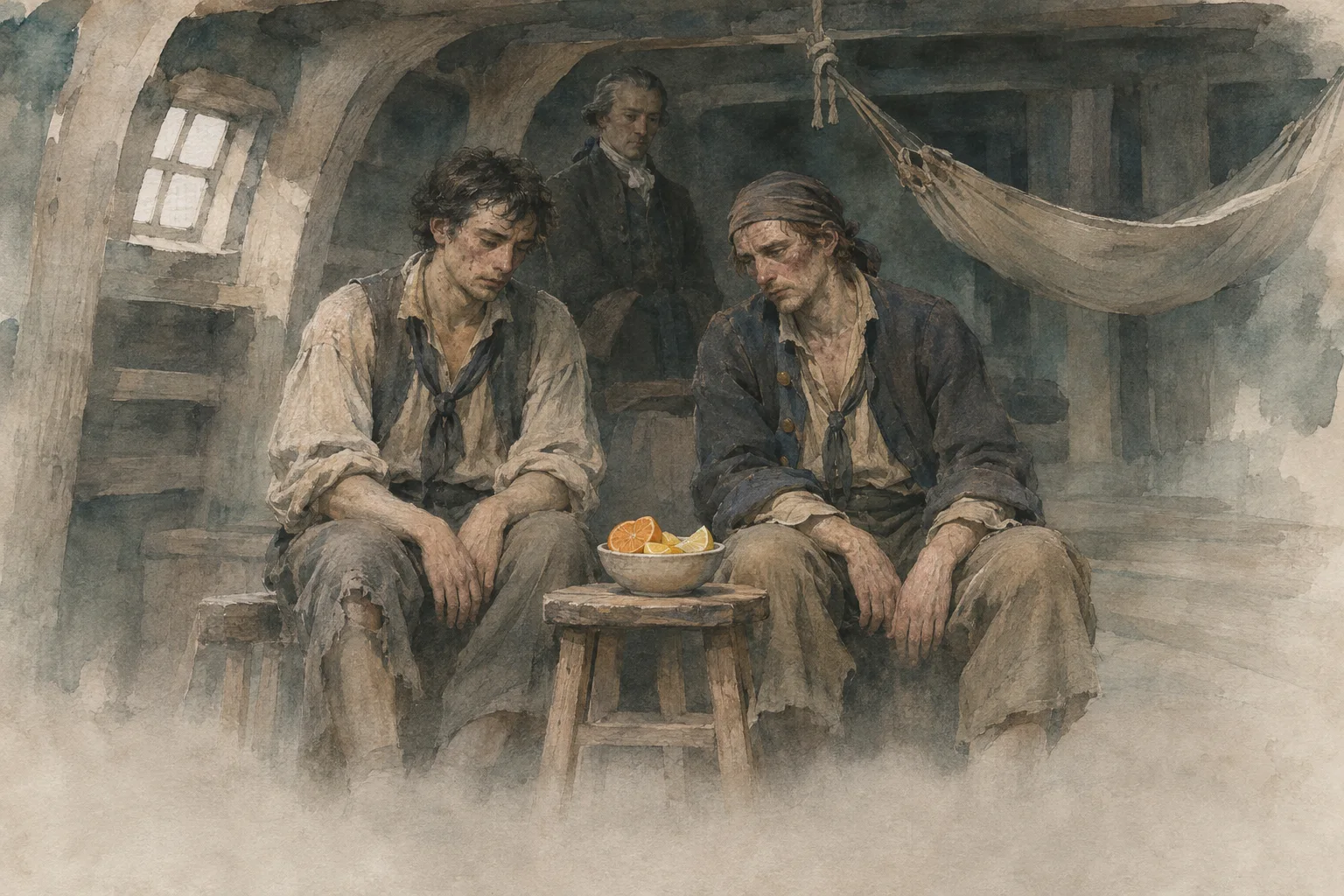
On a ship at sea in the spring of 1747, James Lind gave twelve sick men six different things to swallow and watched what happened over a fortnight. In May 1796, at Berkeley in Gloucestershire, Edward Jenner took matter from a sore on a dairymaid's hand, inserted it into the arm of a boy by two shallow incisions and, some weeks later, inserted smallpox matter into the same boy to see whether anything followed. Neither man ran what a modern reader would call a controlled trial. Both wrote a report, and both reports now stand, in the histories of scurvy and of smallpox and in the modern platform records read here, near the point at which medicine began to test its remedies rather than assert them.
This article asks a narrower question than whether those moments deserve their place. It asks what the two reports themselves claimed, and how far those claims went beyond what the trial each describes could show. A trial can show only what its arms, its subjects, its duration and its measure allow. A report can claim anything its author is willing to sign. The distance between the two is a fact about each document, and it can be read off the page before any later judgment about the authors' merit.
The question matters for a debate in the history of medicine about where the authority of a trial comes from. One side, represented here by Harry Marks's history of therapeutic reform in the United States, holds that the controlled clinical trial grew out of reformers' distrust of the individual physician's judgment and of commercial claims, and that its authority was built over decades by disciplining knowledge through collective, controlled experiment (Marks 1997). On that account, an eighteenth-century trial report is a document of the very thing the later discipline was built to replace: one practitioner's judgment, vouched for by himself. A second line, from the history of quantification, holds that rule-bound methods are pursued most by weak or contested experts as a substitute for personal trust (Porter 1995), and that eighteenth-century physicians already turned to counts, the bills of mortality and new tallies, to settle questions such as whether smallpox inoculation was worth its risk, with the trust those counts won depending on how they were gathered and who vouched for them (Rusnock 2002). Set side by side, these accounts disagree about timing and about motive. Marks places the decisive change late and in the hands of reformers; Rusnock places an earlier version of it in the century of Lind and Jenner; Porter explains the turn to rules by the weakness of those who make it.
The two reports are a test those accounts rarely receive in the actors' own words. If Marks is right that the trial's authority came later and collectively, the reports should rest on personal judgment and personal vouching, and their claims should run ahead of their designs in ways a later discipline would forbid. If Rusnock's earlier numerical culture reached these authors, they should argue at least partly from counts. If Porter's link between weakness and rules holds, Jenner, whose first report the Royal Society did not accept and who then printed the Inquiry privately (Riedel 2005), should be the one who reaches for rule and number.
The contribution of this article is to read both reports at length against that set of expectations, and to bring in beside them the modern summaries that Skeptron, a history studio of the RISCON family, wrote of each case. Those summaries are useful for a different reason. They are written now, for a platform that asks of every historical case what was known at the time and what came only later, and they show what a careful modern reader keeps and what such a reader adds when turning an eighteenth-century report into a short record. The article finds that the two reports rest almost wholly on the author's person, that both name their own limits more often than a reader of later summaries would expect, and that the larger claims sit in particular sentences that can be pointed to. It does not conclude that either author claimed too much. Where the evidence leaves the matter open, the article says so.
The plan of the article is simple. Section 2 lays out the debate. Section 3 describes the texts, the records and the study ledger from which this article is drawn. Sections 4 and 5 read Lind and Jenner in turn. Section 6 brings the two together against the debate, and Section 7 states the contribution and its limits.